
Chaotic ADvection and Mixing Enhancement in Porous Media: The Quest for Experimental Evidence (ChaosAD)
Start Date: 01.04.2024 | End Date: 31.12.2026
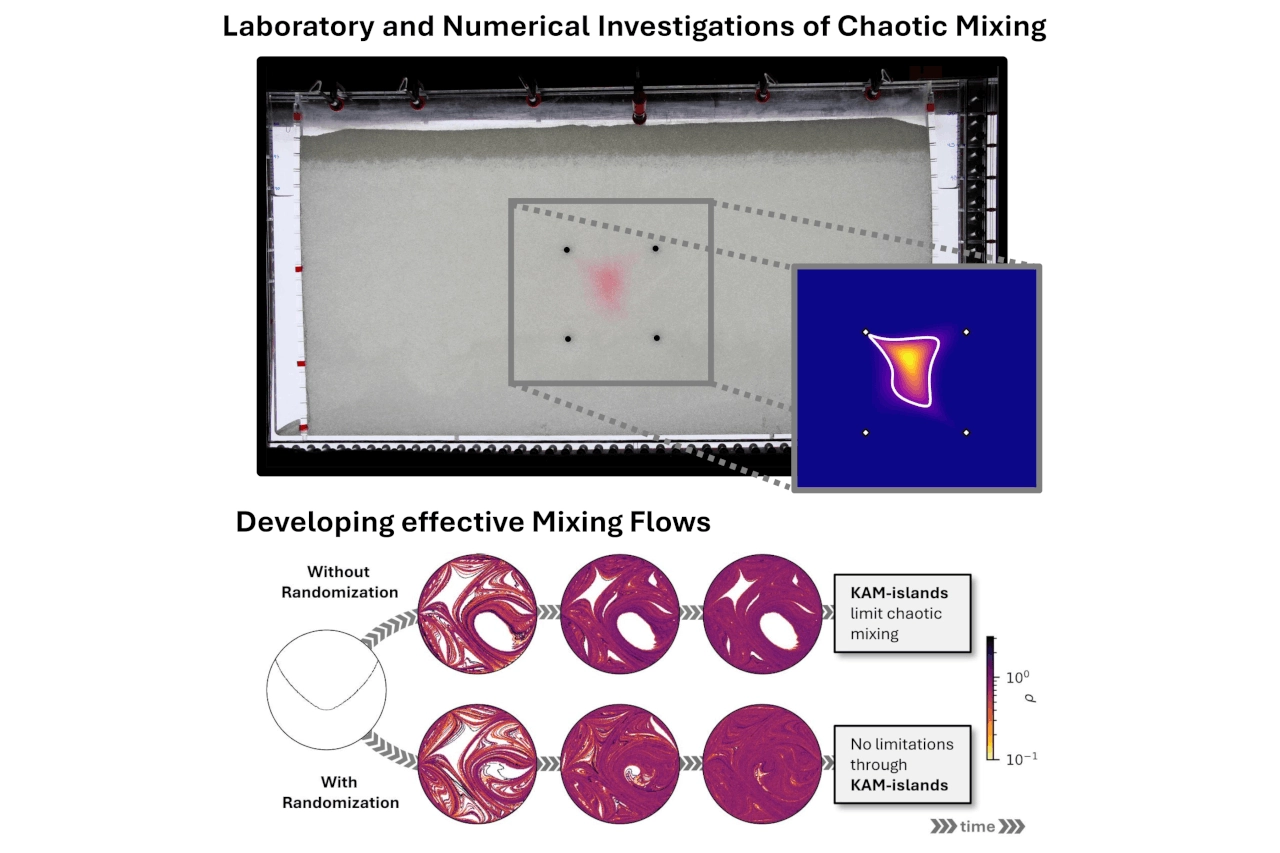
Mixing of fluids is of primary importance in many fields of science and technology. Considering porous media, mixing processes are generally inefficient, but mixing enhancement can be potentially achieved by enhancing plume deformation through stretching and folding, engineering the flow field using injection-extraction systems or in systems naturally displaying a complex transient dynamic such as the effect of tides. Previous studies have been performed at multiple scales (i.e. pore-scale, Darcy-scale, field and regional scale) mainly utilizing theoretical and modelling approaches, while experimental studies performed under controlled conditions are sparse. This research has provided experimental evidence of the effects of chaotic advection on solute transport in saturated porous media under controlled laboratory conditions. The experimental work was accompanied by the development of new advanced numerical methods to perform an accurate model-based interpretation of the results. In addition, multi-parametric studies will also be performed in order to explore realistic scenarios which are beyond the scope of laboratory experiments.
This research project is innovative since it will investigate:
1) the effect of non-linear velocity dependence of dispersion and non-Fickian transport on chaotic advection
2) the effect of incomplete mixing at the pore scale on the effective mixing enhancement due to chaotic advection
3) the effect of the retardation and density effects affecting solute transport of chemically relevant species on the mixing enhancement achieved through chaotic advection
4) the effect of chaotic advection on reactive processes. Moreover, we aim at providing a link between metrics describing chaotic advection and mixing at the Darcy scale which is actually missing and it can be achieved using a model-based interpretation of the experimental results collected in this research project.
Funding Organisation:
DFG-Einzelförderung / Sachbeihilfe (EIN-SBH)