
Bachelor’s Degree in GeoSustainability – Earth System, Resources, Biodiversity
This study programme is taught in German. International students require a DSH certificate (written level 2/oral level 1) or an equivalent qualification to apply for this programme.
Are you interested in the Earth System and sustainability? Do you want to better understand climate change and its causes? Would you like to support the sustainable exploration of resources? Do you enjoy studying natural sciences and practical work?
Then study GeoSustainability at the GeoZentrum Nordbayern at the Friedrich-Alexander-Universität Erlangen Nuremberg!
Degree Program Overview
Fact Sheet
Degree: Bachelor of Science (B.Sc.)
Admission: No Admissions Restrictions
Duration of studies: 6 semesters
Teaching language: completely in German
Faculty: Faculty of Sciences
Start of degree program: Winter semester
Special features:
During the study program, there is the opportunity for an exchange semester in the fourth semester as part of the mobility period on offer. This can be in Germany or abroad.
In addition to theoretical lectures, the program includes seminars and numerous practical courses. These include laboratory work, rock identification, and field exercises.
Link to the current module handbooks and examination regulations:
https://www.gzn.nat.fau.eu/study/downloads/#sprungmarke2
The GeoSustainability degree program provides a deep insight into the Earth System and its processes, as well as the most important geoscientific challenges, such as climate change, sustainable resources, and biodiversity. The global climate and ecosystems are undergoing constant change. New resources will be needed for the transformation of energy systems and technologies will need to be further developed. We provide and develop sustainable solutions to these challenges. In order to understand the processes of the Earth System, natural and geoscientific principles are taught both theoretically in lectures and seminars, and practically in field and laboratory exercises. The teaching is based on the current state of research and provides valuable insights into current important research topics.
The completion of the bachelor’s degree program in GeoSustainability qualifies students for our master’s degree program M.Sc. Geosciences.
By successfully completing the Bachelor’s program in GeoSustainability, you qualify for admission to the Master’s program (M.Sc.) in Geosciences.
Program overview
What is the degree program about?
The GeoSustainability degree program is a modern and diverse geoscientific program focusing on key sustainability issues.
The course focuses on the processes and interactions of the Earth System and the composition, structure, evolution, present and future state of our planet and its habitats. All geoscientific processes of the Earth System in the lithosphere, hydrosphere, and biosphere are analyzed. This includes all geological, chemical, physical, and biological processes that have taken place and are taking place from the formation of the Earth to its present appearance.
In the first two semesters, students study the challenges of sustainability in the Earth System, focusing on resources, climate and biodiversity. Students are introduced to the basics of natural sciences and geosciences.
The third and fourth semesters serve to consolidate and specialize. During this time, the geoscientific basics are deepened and applied through laboratory and field exercises. In addition, practical training, seminars, lectures and exercises are offered to further consolidate knowledge and subsequently specialize in specific areas. A special feature of the fourth semester is a mobility phase. This means that students can spend this semester at a university in Germany of abroad if they are interested. We support them in this.
In the fifth and sixth semesters, students develop solutions to geoscientific challenges in the research phase, for example by modelling biodiversity.
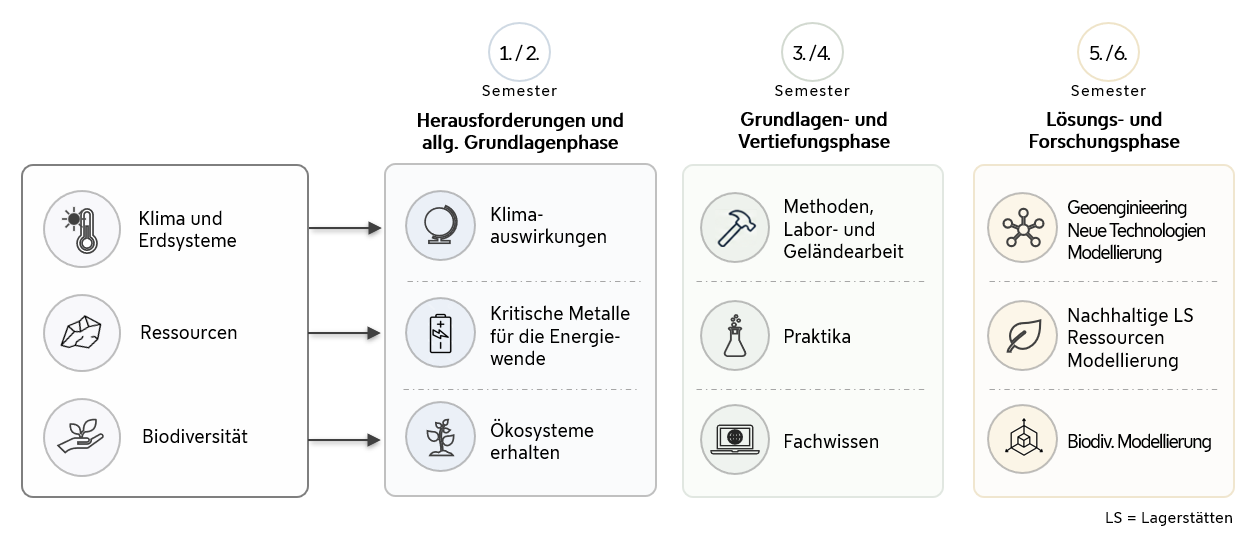
The program focuses on resources, climate, biodiversity and processes of the Earth system. Depending on your interests, you will specialize in one of these areas during your studies.
Enthusiasm for the Earth System, climate research, sustainability research, and, ideally, rocks. You should also have general interest in natural sciences – such as chemistry, physics, mathematics, and biology.
For more information about career opportunities in the geosciences, please visit our Career Prospects page: https://www.gzn.nat.fau.eu/study/profession-geoscientist/.
Here, you can also learn more about career paths of our Alumni: https://www.gzn.nat.fau.eu/prospective-students/career-paths-after-graduation/.
Information on Enrollment for the Bachelor’s Program in GeoSustainability
There is currently no admission restriction (numerus clausus) for the Bachelor’s program in Geo-Sustainability at the University of Erlangen–Nuremberg. The program can be started each winter semester.
Enrollment consists of two steps:
- Online via the portal www.campo.fau.de; the online portal approximatly opens in early June.
- In person at the Student Administration Office (Studierendenkanzlei), Halbmondstraße 6, Room 0.034. You can find the dates for in-person enrollment for degree programs without admission restrictions here.
Information about introductory events at FAU for the start of your studies can be found here.
Enrollment for the summer semester is only possible if you are transferring from another university within the same Geo-Sustainability program.
Further Information on the Degree Program
Information for Geosciences Bachelor’s Students
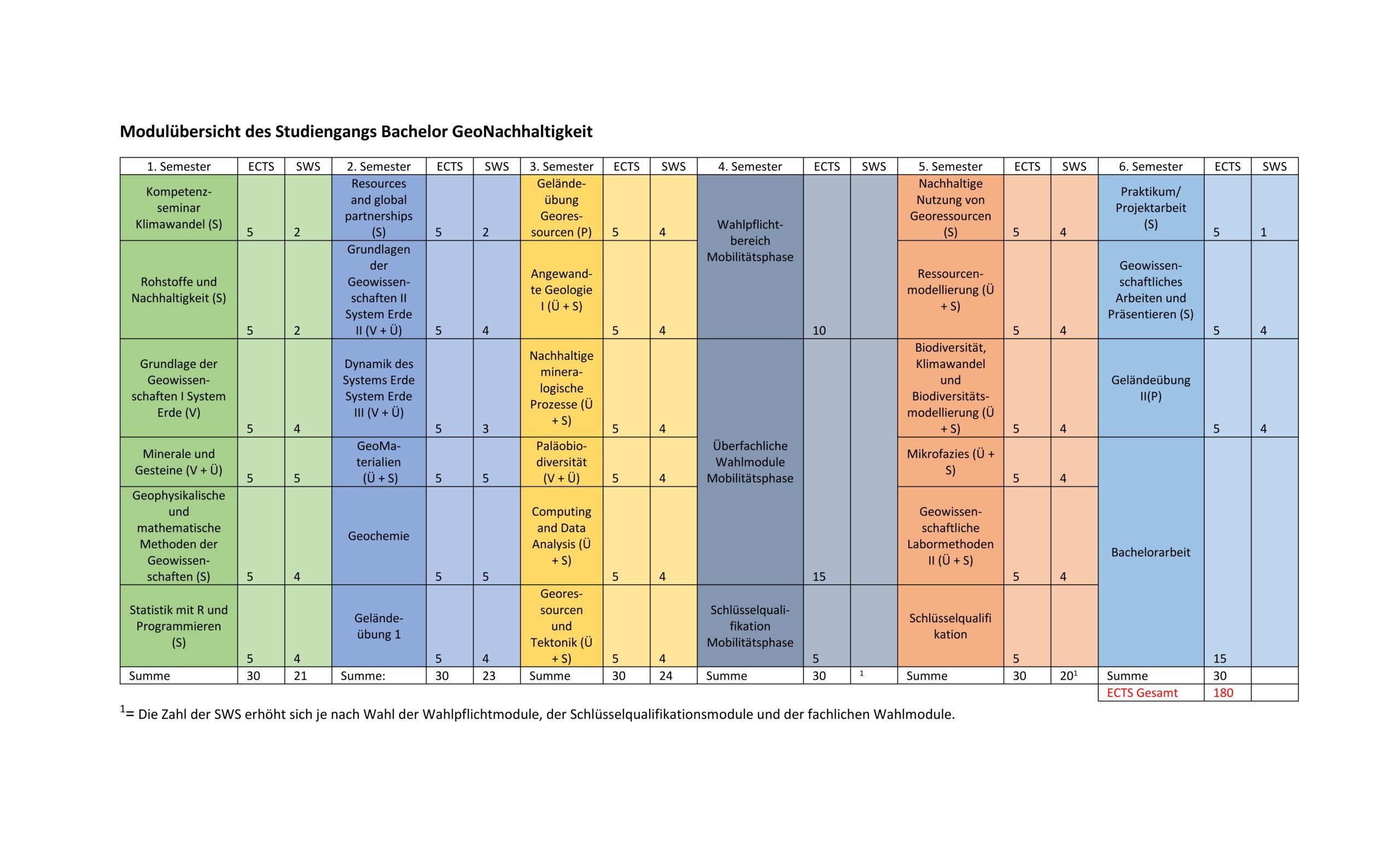
In the module plan (German) for the Bachelor’s program in GeoSustainability, all individual modules of the program at the GeoCenter are listed. Each module is generally completed with an examination. The standard period of study is six semesters. Each semester comprises 30 ECTS credits. In total, 180 ECTS credits are earned during the Bachelor’s program.
The fourth semester of the Geo-Sustainability program is a mobility semester. During this phase, there is the opportunity to …
- complete a semester abroad at a university of your choice, or
- take elective courses offered by the GeoCenter, or
- take interdisciplinary elective modules from the GeoCenter’s course offerings, from other natural science programs at FAU, as well as key qualification courses offered by FAU and EELISA.
In the 6th semester, the program concludes with the Bachelor’s thesis.
Campo contains all module catalogs and information on when and where a course takes place, as well as the names and contact details of the responsible instructors. It also includes room schedules and contact information for FAU staff. Additional content will follow shortly…
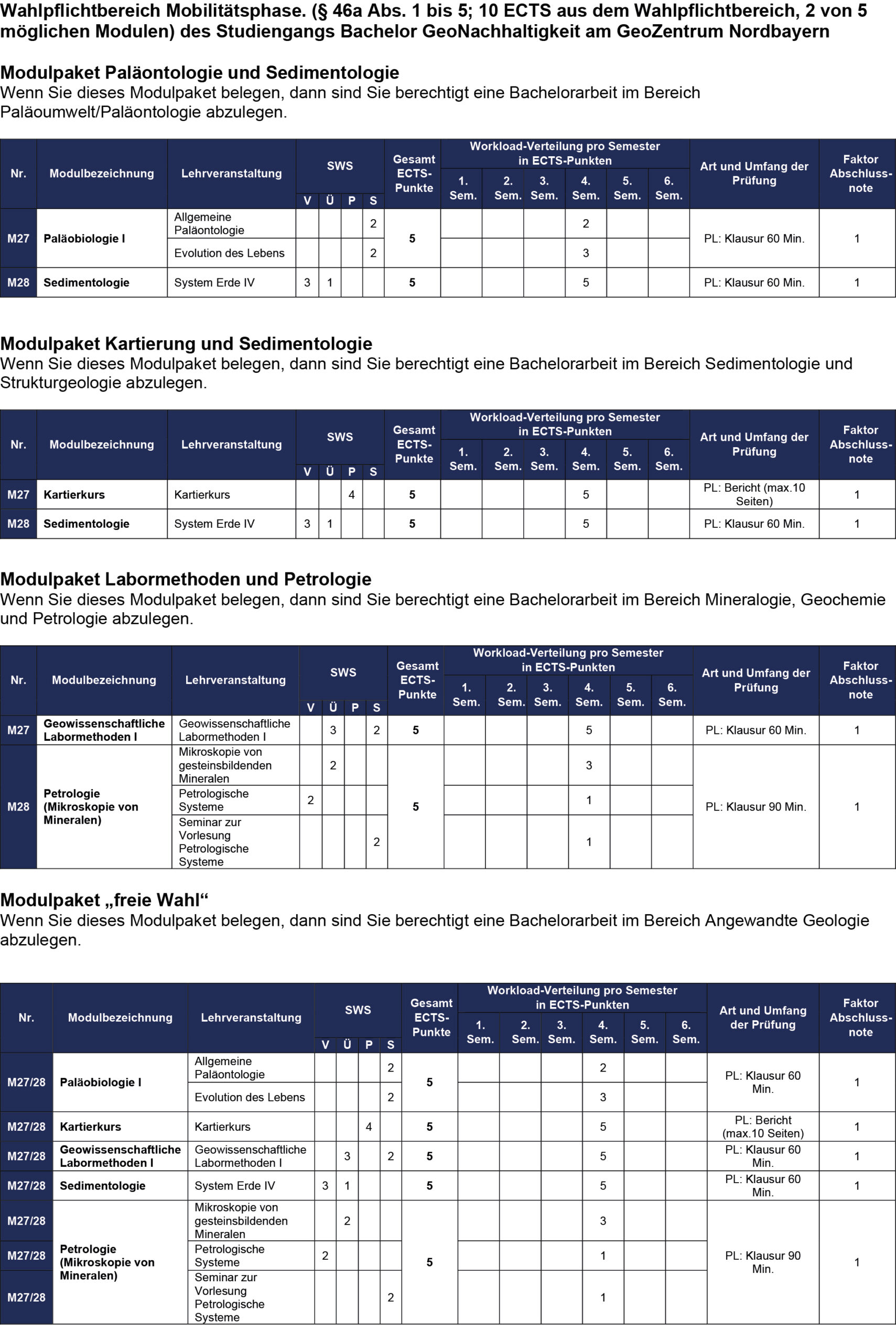
Students in the fourth semester have the opportunity to complete an exchange semester at a university of their choice. It is important to secure a placement abroad or within Germany in a timely manner. During this period, students must earn 25 ECTS credits from the courses offered locally. Of these, 10 ECTS must come from courses equivalent to one of the elective course packages, meaning that the module content must match. The module contents are defined in the Examination Regulations (FPO) (Link), § 52, paragraph 3.
Different module packages can be selected. The choice of module package determines the area in which the Bachelor’s thesis can be completed:
- Paleobiology and Sedimentology Module Package: eligible for a Bachelor’s thesis in Paleoenvironment / Paleobiology.
- Mapping and Sedimentology Module Package: eligible for a Bachelor’s thesis in Sedimentology and Structural Geology.
- Laboratory Methods and Petrology Module Package: eligible for a Bachelor’s thesis in Mineralogy, Geochemistry, and Petrology.
- “Free Choice” Module Package from the course offerings: eligible for a Bachelor’s thesis in Applied Geology.