
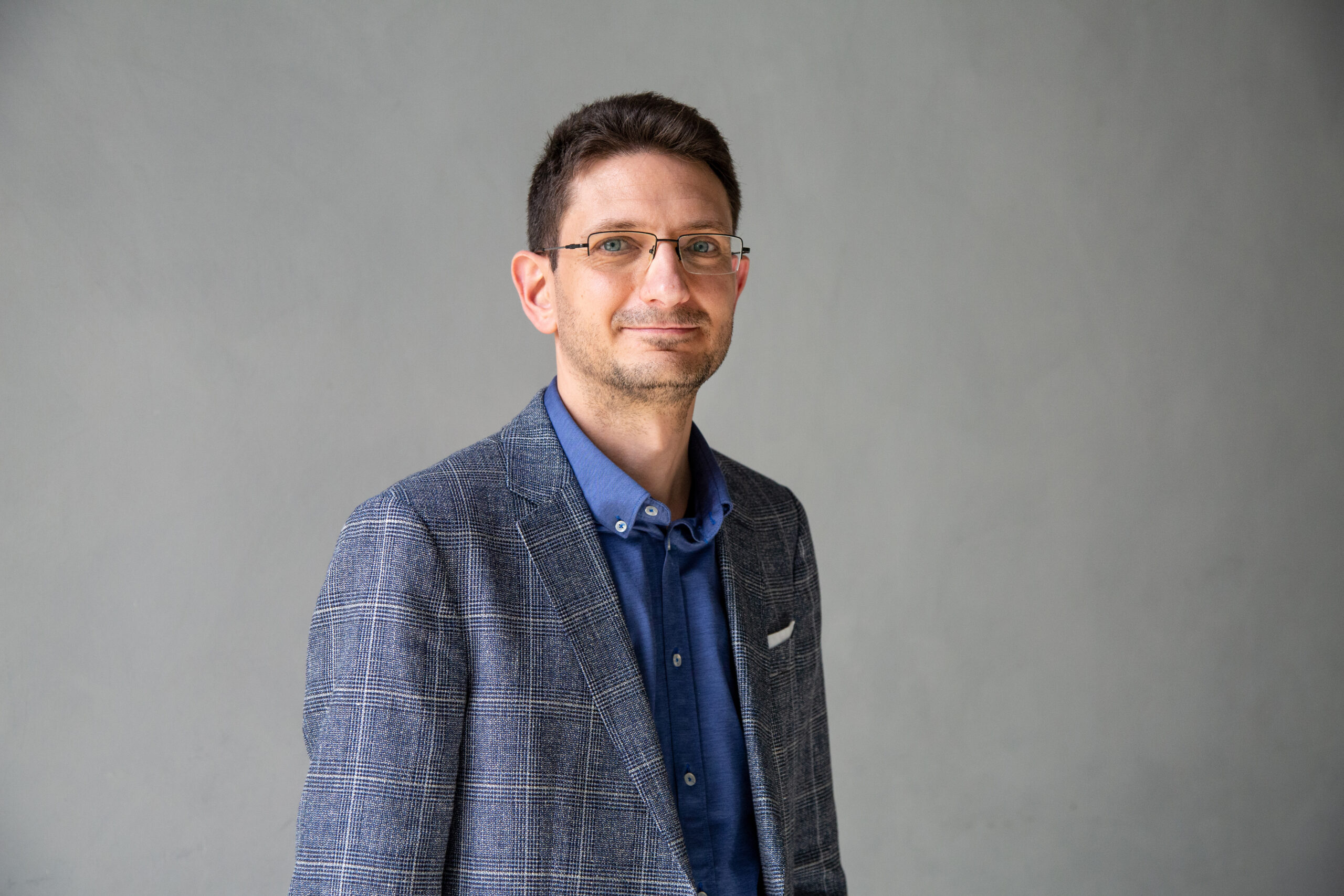
Prof. Dr. Gabriele Chiogna
Professorship for Applied Geology and Environmental Systems Modeling
Professors
Address
Contact
Research Interests
- Modelling of karst and porous aquifers
- Mixing processes
- Alpine hydrology
- Environmental impacts of hydropower production
Curriculum Vitae
Civil status: Married, 3 children.
Education
- 06.11.2019 | German Habilitation in Hydrology | TU Munich
- 05.04.2017 | Italian Habilitation in Sector 08/A1 Hydraulics, Hydrology and Hydraulic Constructions
- 2007 – 2011 | Ph.D. Degree in Geology, University of Tuebingen, Germany | Thesis: “Transverse mixing of conservative and reactive tracers in porous media‟.
- 2010 | Visiting PhD student at Stanford University, USA. (October – December).
- 2007 – 2009 | Master’s degree in Applied Environmental Geosciences, University of Tübingen | Thesis: “The Relevance of Compound Dependent Dispersion Coefficients for Modeling of Mixing-Controlled Reactive Transport”.
- 2005 – 2007 | Italian-German Double degree program in Physics, University of Tübingen and University of Trento | Thesis: “The Derivative Riemann Problem in Special Relativistic Hydrodynamics”.
- 2002 – 2005 | Bachelor’s degree in Physics, University of Trento, Italy | Thesis: “Electric characterization of BJT silicon radiation detectors”.
Professional Career
- 01.04.2024 – present | Professor of Applied Geology and Modeling of Environmental Systems |Friedrich-Alexander-Universität Erlangen-Nürnberg, Germany
- 2023 – present | Board member of the hydropeaking research network
- 2023 – present | Associate editor Journal of Hydrology
- 2022 | Editors’ Citation for Excellence in Refereeing for Water Resources Research
- 2021 | Editors’ Citation for Excellence in Refereeing for Water Resources Research
- 01.03.2021 – present | Adjunct Professor of Sustainable Resources Management | University of Innsbruck, Austria
- 07.11.2019 – 31.03.2024 | Privat Dozent at the Chair of Hydrology and River Basin Management, Faculty of Civil, Geo and Environmental Engineering | Technical University of Munich, Germany
- 10.2016 – present | Associate Editor Hydrological Science Journal
- 10.01.2021 – 31.12.2021 | Participation to the Flying Faculty Program of the German Jordanian University, Visiting Lecturer
- 01.10.2016 – 30.09.2020 | Professor of Sustainable Resources Management | University of Innsbruck, Austria
- 01.01.2015 – 06.11.2019 | Group Leader at the Chair of Hydrology and River Basin Management, Faculty of Civil, Geo and Environmental Engineering | Technical University of Munich, Germany
- 31.10.2012 – 17.02.2017 | Board member and founder of the Academic spin-off of the University of Trento Smart Hydrogeological Solutions srl | Italy
- 15.04.2011 – 31.03.2015 | Freelance scientific consultant (groundwater risk assessment, groundwater remediation, applied research projects, patent management and application)
- 01.09-2015 – 31.10.2015 | Visiting lecturer at the Department of Civil Environmental and Mechanical Engineering | University of Trento, Italy
- 01.04.2013 – 15.01.2015 | Post-Doctoral Fellow at the Center for Applied Geoscience | University of Tübingen, Germany
- 01.11.2013 – 10.12.2013 | Visiting scientist in the Department of Civil Engineering | Universidad de Chile, Chile
- 21.03.2011 – 20.03.2013 | Post-Doctoral Fellow at the department of Civil and Environmental Engineering | University of Trento, Italy
Schlüsselpublikationen
- Chiogna G., Eberhardt C., Grathwohl P., Cirpka O.A. and Rolle M. (2010), Evidence of compound dependent hydrodynamic and mechanical transverse dispersion by multi-tracer laboratory experiments, Environ. Science and Technology, 44, 666-693. doi:10.1021/es9023964
- Chiogna G., Hochstetler D. L., Bellin A., Kitanidis P. K. and Rolle M. (2012), Mixing, entropy and reactive solute transport, Geophys. Res. Lett., 39, L20405. doi:10.1029/2012GL053295.
- Chiogna G., Cirpka O.A., Rolle M. and Bellin A. (2015) Helical flow in three-dimensional non-stationary anisotropic heterogeneous porous media. Water Resour. Res. doi: 10.1002/2014WR015330.
- Marcolini G., Bellin A. and Chiogna G. (2017) Performance of the Standard Normal Homogeneity Test for the homogenization of mean seasonal snow depth time series, International Journal of Climatology 37 (S1), 1267-1277
- Chiogna G., Marcolini G., Liu W., Pèrez Ciria T. and Tuo Y. (2018) Coupling hydrological modelling and support vector regression to model hydropeaking in alpine catchments Sci. Tot. Env., 633, 220-229
- Pérez Ciria T, Labat D, Chiogna G*. (2019). Recent and historical effects of hydropeaking on streamflow time series at multiple spatial and temporal scales in the Adige and Inn River Basins. Journal of Hydrology, 124021
- Bittner, D., Parente, M. T., Mattis, S., Wohlmuth, B., & Chiogna, G. (2020). Identifying relevant hydrological and catchment properties in active subspaces: An inference study of a lumped karst aquifer model. Advances in Water Resources, 135, 103472.
- Matiu, M., Crespi, A., Bertoldi, G., Carmagnola, C. M., Marty, C., Morin, S., … & Kotlarski, S. (2021). Observed snow depth trends in the European Alps 1971 to 2019. The Cryosphere, 1-5
- Basilio Hazas, M., Marcolini, G., Castagna, M., Galli, M., Singh, T., Wohlmuth, B., & Chiogna, G. (2022). Drought conditions enhance groundwater table fluctuations caused by hydropower plant management. Water Resources Research, 58(10), e2022WR032712.
- Richieri, B., Bittner, D., Hartmann, A., Benettin, P., van Breukelen, B. M., Labat, D., & Chiogna, G. (2023). Using continuous electrical conductivity measurements to derive major solute concentrations in karst systems. Hydrological Processes, 37(6), e14929.
2026
- Disse, M., & Chiogna, G. (2026). Impact of solar parks on the local water balance Einfluss von Solarparks auf den lokalen Wasserhaushalt. Hydrologie und Wasserbewirtschaftung, 70(2), 76-.
- Fan, X., Schaefli, B., Hofmeister, F., & Chiogna, G. (2026). When the Past Matters: How Model Initialization Can Lead to Surprises in Long-Term Simulations in Glaciated Environments. Hydrological Processes, 40(4). https://doi.org/10.1002/hyp.70507
- Feistner, C., Basilio Hazas, M., Wohlmuth, B., & Chiogna, G. (2026). The impact of flow randomization in chaotic mixing. Advances in Water Resources, 213. https://doi.org/10.1016/j.advwatres.2026.105325
- Feistner, C., Ziliotto, F., Wohlmuth, B., & Chiogna, G. (2026). Time-varying sensitivity analysis for mixing in chaotic flows: a comparison study. Stochastic Environmental Research and Risk Assessment, 40(3). https://doi.org/10.1007/s00477-025-03125-7
- Tarantik, M., & Chiogna, G. (2026). Einfluss von Photovoltaik-Freiflächenanlagen auf den Bodenwasserhaushalt: Messergebnisse für den Zeitraum Februar bis September 2024. Hydrologie und Wasserbewirtschaftung, 70(2), 132-143.
2025
- Alqadi, M., Zaharieva, S., Commichau, A., Disse, M., Koellner, T., & Chiogna, G. (2025). Developing and Implementing a Decision Support System-Integrated Framework for Evaluating Solar Park Effects on Water-Related Ecosystem Services. Sustainability, 17(7). https://doi.org/10.3390/su17073121
- Ji, H., Chiogna, G., Chang, W., Richieri, B., Chen, L., Luo, M.,... Huang, K. (2025). Investigating the structure of a multiple karst aquifer system and its hydrological process response using high-resolution multi-tracer data. Journal of Hydrology, 657. https://doi.org/10.1016/j.jhydrol.2025.133152
- Ji, H., Chiogna, G., Richieri, B., Fan, X., Huang, K., Chen, C.,... Zhao, H. (2025). High-frequency dual-tracer approach to identify contaminant transport pathways and quantify migration behaviors in karst underground river system. Journal of Hydrology, 662. https://doi.org/10.1016/j.jhydrol.2025.133935
- Richieri, B., & Chiogna, G. (2025). Probabilistic groundwater flood maps for improved risk assessment. Paper presentation at IAHS 2025, Roorkee, India.
- Richieri, B., Sivelle, V., Hartmann, A., Labat, D., Muniruzzaman, M., & Chiogna, G. (2025). LuKARS 3.0: a high-performance computing software to model flow and transport processes in karst aquifers. ENVIRON MODELL SOFTW , 193. https://doi.org/10.1016/j.envsoft.2025.106642
- Schaffhauser, T., Hofmeister, F., Chiogna, G., Merk, F., Tuo, Y., Machnitzke, J.,... Disse, M. (2025). Merits and limits of SWAT-GL: Application in contrasting glaciated catchments. Hydrology and Earth System Sciences, 29(14), 3227-3256. https://doi.org/10.5194/hess-29-3227-2025
- Senarathne, S.L., van Geldern, R., Chandrajith, R., Chiogna, G., & Barth, J. (2025). Implications for the Missing South Asian Carbon Sink: Hydrologic Coupling of Water and Carbon Balances in a Tropical Catchment. Journal of Geophysical Research: Biogeosciences, 130(7). https://doi.org/10.1029/2025JG008839
- Venus, T.E., Ola, O., Alp, M., Bätz, N., Bejarano, M.D., Boavida, I.,... Hayes, D.S. (2025). The power of hydropeaking: Trade-offs between flexible hydropower and river ecosystem services in Europe. Ecological Economics, 233. https://doi.org/10.1016/j.ecolecon.2025.108583
- Ye, Y., Liu, S., Chiogna, G., Lu, C., & Rolle, M. (2025). Density Effects on Mixing in Porous Media: Multi-dimensional Flow-Through Experiments and Model-Based Interpretation. Transport in Porous Media, 152(4). https://doi.org/10.1007/s11242-025-02161-9
- Ziliotto, F., Basilio Hazas, M., Muhr, M., Ahmadi, N., Rolle, M., & Chiogna, G. (2025). Relevance of Local Dispersion on Mixing Enhancement in Engineering Injection and Extraction Systems in Porous Media: Insights from Laboratory Bench-Scale Experiments and Modeling. Transport in Porous Media, 152(3). https://doi.org/10.1007/s11242-025-02155-7
- Ziliotto, F., Merchán-Rivera, P., Basilio Hazas, M., Muhr, M., & Chiogna, G. (2025). Engineered injection-extraction systems: sensitivity analysis and implications for groundwater remediation. Stochastic Environmental Research and Risk Assessment. https://doi.org/10.1007/s00477-025-03046-5
- v. Wenczowski, S., Sakai, Y., Casas-Mulet, R., Chiogna, G., Geist, J., & Manhart, M. (2025). Assessing the Impact of Weak Buoyancy Effects on Hyporheic Exchange: A Study by Pore-Resolved Direct Numerical Simulation. Transport in Porous Media, 152(9). https://doi.org/10.1007/s11242-025-02192-2
- Çallı, K., Chiogna, G., Bittner, D., Sivelle, V., Labat, D., Richieri, B.,... Hartmann, A. (2025). Karst Water Resources in a Changing World: Review of Solute Transport Modeling Approaches. Reviews of Geophysics, 63(1). https://doi.org/10.1029/2023RG000811
2024
- Basilio Hazas, M., Marcolini, G., Wohlmuth, B., & Chiogna, G. (2024). Indicators for the Assessment of the Impact of Hydropeaking on Aquifers. Geophysical Research Letters, 51(12). https://doi.org/10.1029/2023GL107611
- Chiogna, G., Marcolini, G., Engel, M., & Wohlmuth, B. (2024). Sensitivity analysis in the wavelet domain: a comparison study. Stochastic Environmental Research and Risk Assessment, 38(4), 1669-1684. https://doi.org/10.1007/s00477-023-02654-3
- Feistner, C., Basilio Hazas, M., Wohlmuth, B.I., & Chiogna, G. (2024). Impact of Chaotic Advection on Solute Transport in Porous Media. Poster presentation at European Geosciences Union General Assembly 2024 (EGU24), Vienna, AT.
- Friedrich, S., Gerner, A., Tarantik, M., Chiogna, G., & Disse, M. (2024). Assessment of rewetting scenarios under varying climate conditions in a partially restored raised bog in Bavaria, Germany. Journal of Hydrology: Regional Studies, 52. https://doi.org/10.1016/j.ejrh.2024.101695
- Richieri, B., Bittner, D., Sivelle, V., Hartmann, A., Labat, D., & Chiogna, G. (2024). On the value of hydrochemical data for the interpretation of flow and transport processes in the Baget karst system, France. Hydrogeology Journal. https://doi.org/10.1007/s10040-024-02801-2
- Richieri, B., Bittner, D., Sivelle, V., Hartmann, A., Labat, D., & Chiogna, G. (2024). On the value of hydrochemical data for the interpretation of flow and transport processes in the Baget karst system, France. Hydrogeology Journal. https://doi.org/10.1007/s10040-024-02801-2
- Schaffhauser, T., Tuo, Y., Hofmeister, F., Chiogna, G., Huang, J., Merk, F., & Disse, M. (2024). SWAT-GL: A new glacier routine for the hydrological model SWAT. Journal of the American Water Resources Association. https://doi.org/10.1111/1752-1688.13199
- Soltanian, M.R., Moeini, F., Dai, Z., Sawyer, A.H., Fleckenstein, J.H., Doherty, J.,... Madani, K. (2024). Sustainability Nexus AID: groundwater. Sustainability Nexus Forum, 32(1). https://doi.org/10.1007/s00550-024-00557-7
- van Tiel, M., Aubry-Wake, C., Somers, L., Andermann, C., Avanzi, F., Baraer, M.,... Yapiyev, V. (2024). Cryosphere–groundwater connectivity is a missing link in the mountain water cycle. Nature Water, 2(7), 624-637. https://doi.org/10.1038/s44221-024-00277-8
2023
- Alqadi, M., Al Dwairi, A., Merchán-Rivera, P., & Chiogna, G. (2023). Presentation of DeMa (Decision Support Software and Database for Wellfield Management) and Its Application for the Wadi Al Arab Wellfield. Water, 15(2). https://doi.org/10.3390/w15020331
- Basilio Hazas, M., Ziliotto, F., Lee, J., Rolle, M., & Chiogna, G. (2023). Evolution of plume geometry, dilution and reactive mixing in porous media under highly transient flow fields at the surface water-groundwater interface. Journal of Contaminant Hydrology, 258. https://doi.org/10.1016/j.jconhyd.2023.104243
- Hayes, D.S., Bruno, M.C., Alp, M., Boavida, I., Batalla, R.J., Bejarano, M.D.,... Venus, T.E. (2023). 100 key questions to guide hydropeaking research and policy. Renewable & Sustainable Energy Reviews, 187. https://doi.org/10.1016/j.rser.2023.113729
- Hofmeister, F., Graziano, F., Marcolini, G., Willems, W., Disse, M., & Chiogna, G. (2023). Quality assessment of hydrometeorological observational data and their influence on hydrological model results in Alpine catchments. Hydrological Sciences Journal-Journal Des Sciences Hydrologiques, 68(4), 552-571. https://doi.org/10.1080/02626667.2023.2172335
- Hofmeister, F., Venegas, B.R., Sentlinger, G., Tarantik, M., Blume, T., Disse, M., & Chiogna, G. (2023). Automated streamflow measurements in high-elevation Alpine catchments. River Research and Applications, 39(10), 2079-2091. https://doi.org/10.1002/rra.4203
- Manoj J, A., Pérez Ciria, T., Chiogna, G., Salzmann, N., & Agarwal, A. (2023). Characterising the coincidence of soil moisture – precipitation extremes as a possible precursor to European floods. Journal of Hydrology, 620. https://doi.org/10.1016/j.jhydrol.2023.129445
- Richieri, B., Bittner, D., Hartmann, A., Benettin, P., Van Breukelen, B.M., Labat, D., & Chiogna, G. (2023). Deriving Major Ion Concentrations at High Resolution from Continuous Electrical Conductivity Measurements in Karst Systems. In Proceedings of the Eurokarst 2022. Malaga, Spain.
- Richieri, B., Bittner, D., Hartmann, A., Benettin, P., van Breukelen, B.M., Labat, D., & Chiogna, G. (2023). Using continuous electrical conductivity measurements to derive major solute concentrations in karst systems. Hydrological Processes, 37(6). https://doi.org/10.1002/hyp.14929
2022
- Alqadi, M., Aldwairi, A., Margane, A., Brueckner, F., Schneider, M., Merchán-Rivera, P., & Chiogna, G. (2022). Development of a User-friendly Tool for Groundwater Wellfields Management. In Proceedings of the IAHR World Congress (pp. 3347-3356). Granada, ESP: International Association for Hydro-Environment Engineering and Research.
- Basilio Hazas, M., & Chiogna, G. (2022). Effects of Highly Transient Boundary Conditions on Groundwater Solute Transport. In Proceedings of the IAHR World Congress (pp. 3832-3840). Granada, ESP: International Association for Hydro-Environment Engineering and Research.
- Basilio Hazas, M., Marcolini, G., Castagna, M., Galli, M., Singh, T., Wohlmuth, B., & Chiogna, G. (2022). Drought Conditions Enhance Groundwater Table Fluctuations Caused by Hydropower Plant Management. Water Resources Research, 58(10). https://doi.org/10.1029/2022WR032712
- Basilio Hazas, M., Ziliotto, F., Rolle, M., & Chiogna, G. (2022). Linking mixing and flow topology in porous media: An experimental proof. Physical Review E, 105(3). https://doi.org/10.1103/PhysRevE.105.035105
- Beddrich, J., Gupta, S., Wohlmuth, B., & Chiogna, G. (2022). The importance of topographic gradients in alpine permafrost modeling. Advances in Water Resources, 170. https://doi.org/10.1016/j.advwatres.2022.104321
- Hofmeister, F., Arias-Rodriguez, L.F., Premier, V., Marin, C., Notarnicola, C., Disse, M., & Chiogna, G. (2022). Intercomparison of Sentinel-2 and modelled snow cover maps in a high-elevation Alpine catchment. Journal of Hydrology X, 15. https://doi.org/10.1016/j.hydroa.2022.100123
- Hofmeister, F., Spadina, A., & Chiogna, G. (2022). Coupling Support Vector Machine and physically-based Hydrological Modeling for Reducing the Computational Time in Climate Change Studies. In Proceedings of the IAHR World Congress (pp. 4827-4836). Granada, ESP: International Association for Hydro-Environment Engineering and Research.
- Merchán-Rivera, P., Basilio Hazas, M., Marcolini, G., & Chiogna, G. (2022). Propagation of hydropeaking waves in heterogeneous aquifers: effects on flow topology and uncertainty quantification. GEM - International Journal on Geomathematics, 13(1). https://doi.org/10.1007/s13137-022-00202-9
- Merchán-Rivera, P., Geist, A., Disse, M., Huang, J., & Chiogna, G. (2022). A Bayesian framework to assess and create risk maps of groundwater flooding. Journal of Hydrology, 610. https://doi.org/10.1016/j.jhydrol.2022.127797
- Pérez-Ciria, T., Labat, D., & Chiogna, G. (2022). Heterogeneous spatiotemporal streamflow response to large-scale climate indexes in the Eastern Alps. Journal of Hydrology, 615. https://doi.org/10.1016/j.jhydrol.2022.128698
- Singh, T., Gupta, S., Chiogna, G., Krause, S., & Wohlmuth, B. (2022). Impacts of Peak-Flow Events on Hyporheic Denitrification Potential. Water Resources Research, 58(3). https://doi.org/10.1029/2021WR031407
- Sivelle, V., Jourde, H., Bittner, D., Richieri, B., Labat, D., Hartmann, A., & Chiogna, G. (2022). Considering land cover and land use (LCLU) in lumped parameter modeling in forest dominated karst catchments. Journal of Hydrology, 612. https://doi.org/10.1016/j.jhydrol.2022.128264
2021
- Alqadi, M., Al Dwairi, A., Dehnavi, S., Margane, A., Al Raggad, M., Al Wreikat, M., & Chiogna, G. (2021). A novel method to assess the impact of a government’s water strategy on research: A case study of Azraq Basin, Jordan. Water, 13(15). https://doi.org/10.3390/w13152138
- Bittner, D., Engel, M., Wohlmuth, B., Labat, D., & Chiogna, G. (2021). Temporal Scale-Dependent Sensitivity Analysis for Hydrological Model Parameters Using the Discrete Wavelet Transform and Active Subspaces. Water Resources Research, 57(10). https://doi.org/10.1029/2020WR028511
- Bittner, D., Richieri, B., & Chiogna, G. (2021). Unraveling the time-dependent relevance of input model uncertainties for a lumped hydrologic model of a pre-alpine karst system 论阿尔卑斯前缘岩溶系统集总水文模型输入模型不确定性的时间相关性 Comprendre l’importance temporelle des incertitudes des modèles d’entrée pour un modèle hydrologique global d’un système karstique préalpin Desfazendo a relevância temporal das incertezas do modelo de entrada para um modelo hidrológico de um sistema de cárstico pré-alpino Análisis de la relevancia temporal de las incertidumbres en los modelos de entrada para un modelo hidrológico compuesto en un sistema kárstico prealpino. Hydrogeology Journal, 29(7), 2363-2379. https://doi.org/10.1007/s10040-021-02377-1
- Bittner, D., Richieri, B., & Chiogna, G. (2021). Unravelling the time-dependent relevance of model input uncertainties for a lumped hydrologic model of a pre-alpine karst system. Hydrogeology Journal. https://doi.org/10.1007/s10040-021-02377-1
- Matiu, M., Crespi, A., Bertoldi, G., Maria Carmagnola, C., Marty, C., Morin, S.,... Weilguni, V. (2021). Observed snow depth trends in the European Alps: 1971 to 2019. Cryosphere, 15(3), 1343-1382. https://doi.org/10.5194/tc-15-1343-2021
- Merchán-Rivera, P., Wohlmuth, B., & Chiogna, G. (2021). Identifying Stagnation Zones and Reverse Flow Caused by River-Aquifer Interaction: An Approach Based on Polynomial Chaos Expansions. Water Resources Research, 57(12). https://doi.org/10.1029/2021WR029824
- Ziliotto, F., Basilio Hazas, M., Rolle, M., & Chiogna, G. (2021). Mixing Enhancement Mechanisms in Aquifers Affected by Hydropeaking: Insights From Flow-Through Laboratory Experiments. Geophysical Research Letters, 48(21). https://doi.org/10.1029/2021GL095336
2020
- Bittner, D., Parente, M.T., Mattis, S., Wohlmuth, B., & Chiogna, G. (2020). Identifying relevant hydrological and catchment properties in active subspaces: An inference study of a lumped karst aquifer model. Advances in Water Resources, 135. https://doi.org/10.1016/j.advwatres.2019.103472
- Bittner, D., Rychlik, A., Klöffel, T., Leuteritz, A., Disse, M., & Chiogna, G. (2020). A GIS-based model for simulating the hydrological effects of land use changes on karst systems – The integration of the LuKARS model into FREEWAT. ENVIRON MODELL SOFTW , 127. https://doi.org/10.1016/j.envsoft.2020.104682
- Bittner, D., Sheikhy Narany, T., Kohl, B., Disse, M., & Chiogna, G. (2020). Corrigendum to “Modeling the hydrological impact of land use change in a dolomite dominated karst system” (Journal of Hydrology (2018) 567 (267–279), (S0022169418307789), (10.1016/j.jhydrol.2018.10.017)). Journal of Hydrology, 580. https://doi.org/10.1016/j.jhydrol.2019.124191
- Marchina, C., Zuecco, G., Chiogna, G., Bianchini, G., Carturan, L., Comiti, F.,... Penna, D. (2020). Alternative methods to determine the δ2H-δ18O relationship: An application to different water types. Journal of Hydrology, 587. https://doi.org/10.1016/j.jhydrol.2020.124951
- Olarinoye, T., Gleeson, T., Marx, V., Seeger, S., Adinehvand, R., Allocca, V.,... Hartmann, A. (2020). Author Correction: Global karst springs hydrograph dataset for research and management of the world’s fastest-flowing groundwater (Scientific Data, (2020), 7, 1, (59), 10.1038/s41597-019-0346-5). Scientific Data, 7(1). https://doi.org/10.1038/s41597-020-00590-3
- Olarinoye, T., Gleeson, T., Marx, V., Seeger, S., Adinehvand, R., Allocca, V.,... Hartmann, A. (2020). Global karst springs hydrograph dataset for research and management of the world’s fastest-flowing groundwater. Scientific Data, 7(1). https://doi.org/10.1038/s41597-019-0346-5
- Pérez Ciria, T., & Chiogna, G. (2020). Intra-catchment comparison and classification of long-term streamflow variability in the Alps using wavelet analysis. Journal of Hydrology, 587. https://doi.org/10.1016/j.jhydrol.2020.124927
- Pérez Ciria, T., Puspitarini, H.D., Chiogna, G., François, B., & Borga, M. (2020). Multi-temporal scale analysis of complementarity between hydro and solar power along an alpine transect. Science of the Total Environment, 741. https://doi.org/10.1016/j.scitotenv.2020.140179
- Ye, Y., Chiogna, G., Lu, C., & Rolle, M. (2020). Plume deformation, mixing, and reaction kinetics: An analysis of interacting helical flows in three-dimensional porous media. Physical Review E, 102(1). https://doi.org/10.1103/PhysRevE.102.013110
2019
- Alqadi, M., Margane, A., Raggad, M.A., Subah, H.A., Disse, M., Hamdan, I., & Chiogna, G. (2019). Implementation of simple strategies to improve wellfield management in arid regions: The case study of Wadi Al Arab Wellfield, Jordan. Sustainability, 11(21). https://doi.org/10.3390/su11215903
- Cano-Paoli, K., Chiogna, G., & Bellin, A. (2019). Convenient use of electrical conductivity measurements to investigate hydrological processes in Alpine headwaters. Science of the Total Environment, 685, 37-49. https://doi.org/10.1016/j.scitotenv.2019.05.166
- Marcolini, G., Koch, R., Chimani, B., Schöner, W., Bellin, A., Disse, M., & Chiogna, G. (2019). Evaluation of homogenization methods for seasonal snow depth data in the Austrian Alps, 1930–2010. International Journal of Climatology, 39(11), 4514-4530. https://doi.org/10.1002/joc.6095
- Pérez Ciria, T., Labat, D., & Chiogna, G. (2019). Detection and interpretation of recent and historical streamflow alterations caused by river damming and hydropower production in the Adige and Inn river basins using continuous, discrete and multiresolution wavelet analysis. Journal of Hydrology, 578. https://doi.org/10.1016/j.jhydrol.2019.124021
- Rügner, H., Schwientek, M., Milačič, R., Zuliani, T., Vidmar, J., Paunović, M.,... Grathwohl, P. (2019). Particle bound pollutants in rivers: Results from suspended sediment sampling in Globaqua River Basins. Science of the Total Environment, 647, 645-652. https://doi.org/10.1016/j.scitotenv.2018.08.027
- Sheikhy Narany, T., Bittner, D., Disse, M., & Chiogna, G. (2019). Spatial and temporal variability in hydrochemistry of a small-scale dolomite karst environment. Environmental Earth Sciences, 78(9). https://doi.org/10.1007/s12665-019-8276-2
- Teixeira Parente, M., Bittner, D., Mattis, S.A., Chiogna, G., & Wohlmuth, B. (2019). Bayesian Calibration and Sensitivity Analysis for a Karst Aquifer Model Using Active Subspaces. Water Resources Research, 55(8), 7086-7107. https://doi.org/10.1029/2019WR024739
2018
- Bittner, D., Narany, T.S., Kohl, B., Disse, M., & Chiogna, G. (2018). Modeling the hydrological impact of land use change in a dolomite-dominated karst system. Journal of Hydrology, 567, 267-279. https://doi.org/10.1016/j.jhydrol.2018.10.017
- Chiogna, G., Marcolini, G., Liu, W., Pérez Ciria, T., & Tuo, Y. (2018). Coupling hydrological modeling and support vector regression to model hydropeaking in alpine catchments. Science of the Total Environment, 633, 220-229. https://doi.org/10.1016/j.scitotenv.2018.03.162
- Chiogna, G., Skrobanek, P., Narany, T.S., Ludwig, R., & Stumpp, C. (2018). Effects of the 2017 drought on isotopic and geochemical gradients in the Adige catchment, Italy. Science of the Total Environment, 645, 924-936. https://doi.org/10.1016/j.scitotenv.2018.07.176
- Tuo, Y., Marcolini, G., Disse, M., & Chiogna, G. (2018). A multi-objective approach to improve SWAT model calibration in alpine catchments. Journal of Hydrology, 559, 347-360. https://doi.org/10.1016/j.jhydrol.2018.02.055
- Tuo, Y., Marcolini, G., Disse, M., & Chiogna, G. (2018). Calibration of snow parameters in SWAT: comparison of three approaches in the Upper Adige River basin (Italy). Hydrological Sciences Journal-Journal Des Sciences Hydrologiques, 63(4), 657-678. https://doi.org/10.1080/02626667.2018.1439172
- Vigiak, O., Lutz, S., Mentzafou, A., Chiogna, G., Tuo, Y., Majone, B.,... Pistocchi, A. (2018). Uncertainty of modelled flow regime for flow-ecological assessment in Southern Europe. Science of the Total Environment, 615, 1028-1047. https://doi.org/10.1016/j.scitotenv.2017.09.295
- Ye, Y., Chiogna, G., Lu, C., & Rolle, M. (2018). Effect of Anisotropy Structure on Plume Entropy and Reactive Mixing in Helical Flows. Transport in Porous Media, 121(2), 315-332. https://doi.org/10.1007/s11242-017-0964-3
2017
- Avesani, D., Dumbser, M., Chiogna, G., & Bellin, A. (2017). An alternative smooth particle hydrodynamics formulation to simulate chemotaxis in porous media. Journal of Mathematical Biology, 74(5), 1037-1058. https://doi.org/10.1007/s00285-016-1049-6
- Chiogna, G., & Rolle, M. (2017). Entropy-based critical reaction time for mixing-controlled reactive transport. Water Resources Research, 53(8), 7488-7498. https://doi.org/10.1002/2017WR020522
- Mandaric, L., Diamantini, E., Stella, E., Cano-Paoli, K., Valle-Sistac, J., Molins-Delgado, D.,... Petrovic, M. (2017). Contamination sources and distribution patterns of pharmaceuticals and personal care products in Alpine rivers strongly affected by tourism. Science of the Total Environment, 590-591, 484-494. https://doi.org/10.1016/j.scitotenv.2017.02.185
- Marcolini, G., Bellin, A., & Chiogna, G. (2017). Performance of the Standard Normal Homogeneity Test for the homogenization of mean seasonal snow depth time series. International Journal of Climatology, 37, 1267-1277. https://doi.org/10.1002/joc.4977
- Marcolini, G., Bellin, A., Disse, M., & Chiogna, G. (2017). Variability in snow depth time series in the Adige catchment. Journal of Hydrology: Regional Studies, 13, 240-254. https://doi.org/10.1016/j.ejrh.2017.08.007
2016
- Chiogna, G., Cirpka, O.A., & Herrera, P.A. (2016). Helical Flow and Transient Solute Dilution in Porous Media. Transport in Porous Media, 111(3), 591-603. https://doi.org/10.1007/s11242-015-0613-7
- Chiogna, G., Majone, B., Cano Paoli, K., Diamantini, E., Stella, E., Mallucci, S.,... Bellin, A. (2016). A review of hydrological and chemical stressors in the Adige catchment and its ecological status. Science of the Total Environment, 540, 429-443. https://doi.org/10.1016/j.scitotenv.2015.06.149
- Di Dato, M., Fiori, A., Chiogna, G., De Barros, F.P., & Bellin, A. (2016). Impact of the spatial structure of the hydraulic conductivity field on vorticity in three-dimensional flows. Proceedings of the Royal Society A-Mathematical Physical and Engineering Sciences, 472(2187). https://doi.org/10.1098/rspa.2015.0730
- Duan, Z., Liu, J., Tuo, Y., Chiogna, G., & Disse, M. (2016). Evaluation of eight high spatial resolution gridded precipitation products in Adige Basin (Italy) at multiple temporal and spatial scales. Science of the Total Environment, 573, 1536-1553. https://doi.org/10.1016/j.scitotenv.2016.08.213
- Tuo, Y., Duan, Z., Disse, M., & Chiogna, G. (2016). Evaluation of precipitation input for SWAT modeling in Alpine catchment: A case study in the Adige river basin (Italy). Science of the Total Environment, 573, 66-82. https://doi.org/10.1016/j.scitotenv.2016.08.034
- Ye, Y., Chiogna, G., Cirpka, O.A., Grathwohl, P., & Rolle, M. (2016). Experimental investigation of transverse mixing in porous media under helical flow conditions. Physical Review E, 94(1). https://doi.org/10.1103/PhysRevE.94.013113
2015
- Avesani, D., Herrera, P., Chiogna, G., Bellin, A., & Dumbser, M. (2015). Smooth Particle Hydrodynamics with nonlinear Moving-Least-Squares WENO reconstruction to model anisotropic dispersion in porous media. Advances in Water Resources, 80, 43-59. https://doi.org/10.1016/j.advwatres.2015.03.007
- Castagna, M., Bellin, A., & Chiogna, G. (2015). Uncertainty estimation and evaluation of shallow aquifers' exploitability: The case study of the Adige valley aquifer (Italy). Water, 7(7), 3367-3395. https://doi.org/10.3390/w7073367
- Cirpka, O.A., Chiogna, G., Rolle, M., & Bellin, A. (2015). Transverse mixing in three-dimensional nonstationary anisotropic heterogeneous porous media. Water Resources Research, 51(1), 241-260. https://doi.org/10.1002/2014WR015331
- Tuo, Y., Chiogna, G., & Disse, M. (2015). A multi-criteria model selection protocol for practical applications to nutrient transport at the catchment scale. Water, 7(6), 2851-2880. https://doi.org/10.3390/w7062851
- Ye, Y., Chiogna, G., Cirpka, O., Grathwohl, P., & Rolle, M. (2015). Experimental investigation of compound-specific dilution of solute plumes in saturated porous media: 2-D vs. 3-D flow-through systems. Journal of Contaminant Hydrology, 172, 33-47. https://doi.org/10.1016/j.jconhyd.2014.11.002
- Ye, Y., Chiogna, G., Cirpka, O.A., Grathwohl, P., & Rolle, M. (2015). Enhancement of plume dilution in two-dimensional and three-dimensional porous media by flow focusing in high-permeability inclusions. Water Resources Research, 51(7), 5582-5602. https://doi.org/10.1002/2015WR016962
- Ye, Y., Chiogna, G., Cirpka, O.A., Grathwohl, P., & Rolle, M. (2015). Experimental Evidence of Helical Flow in Porous Media. Physical Review Letters, 115(19). https://doi.org/10.1103/PhysRevLett.115.194502
2014
- Chiogna, G., Rolle, M., Bellin, A., & Cirpka, O.A. (2014). Helicity and flow topology in three-dimensional anisotropic porous media. Advances in Water Resources, 73, 134-143. https://doi.org/10.1016/j.advwatres.2014.06.017
- Chiogna, G., Santoni, E., Camin, F., Tonon, A., Majone, B., Trenti, A., & Bellin, A. (2014). Stable isotope characterization of the Vermigliana catchment. Journal of Hydrology, 509, 295-305. https://doi.org/10.1016/j.jhydrol.2013.11.052
2013
- Chiogna, G., & Bellin, A. (2013). Analytical solution for reactive solute transport considering incomplete mixing within a reference elementary volume. Water Resources Research, 49(5), 2589-2600. https://doi.org/10.1002/wrcr.20200
- Hochstetler, D.L., Rolle, M., Chiogna, G., Haberer, C.M., Grathwohl, P., & Kitanidis, P.K. (2013). Effects of compound-specific transverse mixing on steady-state reactive plumes: Insights from pore-scale simulations and Darcy-scale experiments. Advances in Water Resources, 54, 1-10. https://doi.org/10.1016/j.advwatres.2012.12.007
- Rolle, M., Chiogna, G., Hochstetler, D.L., & Kitanidis, P.K. (2013). On the importance of diffusion and compound-specific mixing for groundwater transport: An investigation from pore to field scale. Journal of Contaminant Hydrology, 153, 51-68. https://doi.org/10.1016/j.jconhyd.2013.07.006
2012
- Chiogna, G., Cirpka, O.A., Grathwohl, P., & Rolle, M. (2012). Compound-specific local and effective transverse dispersion coefficients for conservative and reactive mixing in heterogeneous porous media. In IAHS-AISH Publication (pp. 163-168). DEU.
- Chiogna, G., Hochstetler, D.L., Bellin, A., Kitanidis, P.K., & Rolle, M. (2012). Mixing, entropy and reactive solute transport. Geophysical Research Letters, 39(20). https://doi.org/10.1029/2012GL053295
- Cirpka, O.A., Rolle, M., Chiogna, G., De Barros, F.P., & Nowak, W. (2012). Stochastic evaluation of mixing-controlled steady-state plume lengths in two-dimensional heterogeneous domains. Journal of Contaminant Hydrology, 138-139, 22-39. https://doi.org/10.1016/j.jconhyd.2012.05.007
- Rolle, M., Hochstetler, D., Chiogna, G., Kitanidis, P.K., & Grathwohl, P. (2012). Experimental Investigation and Pore-Scale Modeling Interpretation of Compound-Specific Transverse Dispersion in Porous Media. Transport in Porous Media, 93(3), 347-362. https://doi.org/10.1007/s11242-012-9953-8
2011
- Chiogna, G., Cirpka, O.A., Grathwohl, P., & Rolle, M. (2011). Relevance of local compound-specific transverse dispersion for conservative and reactive mixing in heterogeneous porous media. Water Resources Research, 47(7). https://doi.org/10.1029/2010WR010270
- Chiogna, G., Cirpka, O.A., Grathwohl, P., & Rolle, M. (2011). Transverse mixing of conservative and reactive tracers in porous media: Quantification through the concepts of flux-related and critical dilution indices. Water Resources Research, 47(2). https://doi.org/10.1029/2010WR009608
- Cirpka, O.A., De Barros, F.P., Chiogna, G., & Nowak, W. (2011). Probability density function of steady state concentration in two-dimensional heterogeneous porous media. Water Resources Research, 47(11). https://doi.org/10.1029/2011WR010750
- Cirpka, O.A., De Barros, F.P., Chiogna, G., Rolle, M., & Nowak, W. (2011). Stochastic flux-related analysis of transverse mixing in two-dimensional heterogeneous porous media. Water Resources Research, 47(6). https://doi.org/10.1029/2010WR010279
- Rolle, M., Chiogna, G., Eberhardt, C., Haberer, C., Griebler, C., Cirpka, O.A., & Grathwohl, P. (2011). Two-dimensional flow-through experiments: Versatile test systems for a combined investigation of transport and reactive processes in porous media. In IAHS-AISH Publication (pp. 259-262). CHE.
2010
- Chiogna, G., Eberhardt, C., Grathwohl, P., Cirpka, O.A., & Rolle, M. (2010). Evidence of compound-dependent hydrodynamic and mechanical transverse dispersion by multitracer laboratory experiments. Environmental Science & Technology, 44(2), 688-693. https://doi.org/10.1021/es9023964
- Rolle, M., Chiogna, G., Bauer, R., Griebler, C., & Grathwohl, P. (2010). Isotopic fractionation by transverse dispersion: Flow-through microcosms and reactive transport modeling study. Environmental Science & Technology, 44(16), 6167-6173. https://doi.org/10.1021/es101179f
2009
- Rolle, M., Eberhardt, C., Chiogna, G., Cirpka, O.A., & Grathwohl, P. (2009). Enhancement of dilution and transverse reactive mixing in porous media: Experiments and model-based interpretation. Journal of Contaminant Hydrology, 110(3-4), 130-142. https://doi.org/10.1016/j.jconhyd.2009.10.003
Rivercast: RIVERCAST – KI-gestützte Optimierung der Vorhersage und Steuerung von Hochwasserereignissen
(Third Party Funds Single)Project leader:
Term: 1. October 2025 - 30. September 2028
Acronym: Rivercast
Funding source: andere FörderorganisationDas Projekt RIVERCAST zielt darauf ab, verschiedene Methoden zur Verbesserung des planerischen und operativen Hochwasserschutzes zu entwickeln und im südlichen Erfteinzugsgebiet konkret umzusetzen. Die Ausrichtung orientiert sich dabei stark am 10-Punkte-Arbeitsplan des MULNV (heute MUNV) sowie bekannten Defiziten von Hochwassermangement und Hochwasserschutzplanung. Zentrales Element ist der Einsatz moderner KI-Modelle für die dargestellten Fragestellungen. Diese Modelle verwenden die Daten vorhandener und zusätzlich zu installierender Messtationen und integrieren weitere verfügbare Informationen (radarbasierter Niederschlag, Niederschlagsprognosen, Leitfähigkeiten, Bodenfeuchte, etc.).
Auf diese Weise sollen zum einen die Zuflussprognosen zu bestehenden Hochwasserrückhaltebecken verbessert werden. Der Einsatz KI–basierter Prognosen als Ergänzung zu Niederschlag-Abfluss-basierten Abflussvorhersagen ist unserer Kenntnis nach neu und kann perspektivisch auch zu einer Verbesserung eines landesweiten Hochwasservorhersagesystems beitragen.Transferring knowledge of probabilistic groundwater flood maps for improved risk assessment
(Third Party Funds Single)Project leader: ,
Term: 1. June 2025 - 31. October 2025
Funding source: andere FörderorganisationGrARBeKo: Grundwasserüberschwemmungen: Entwicklung eines Ansatzes zur Risikobewertung und -kommunikation
(Third Party Funds Single)Project leader:
Term: 19. April 2025 - 18. October 2026
Acronym: GrARBeKo
Funding source: Deutsche Bundesstiftung UmweltAsclimate change drives more frequent extreme weather events, groundwaterflooding poses an increasing threat to infrastructure and public safety. TheGrARBeKo project (Grundwasserüberschwemmungen: Entwicklung eines Ansatzes zurRisikobewertung und -kommunikation) addresses this challenge by developing arobust, data-driven methodology for risk assessment and public engagement.
Ledby Friedrich-Alexander-Universität Erlangen-Nürnberg (FAU), the project bringstogether key partners:
- Okeanos Smart Data Solutions GmbH (AI and hydroinformatics),
- Zentrum für Digitale Entwicklung GmbH (ZDE) (citizen participation and strategic communication),
- KI-P GmbH (sensor integration and data visualization), and
- the City of Garching, which contributes monitoring infrastructure and supports public outreach.
UsingGarching as a pilot site, GrARBeKo combines groundwater modeling (MODFLOW) withmachine learning techniques (ML) to generate rapid, high-resolution flood riskmaps. By involving citizens in the installation of low-cost sensors and thecollection of real-world data, such as water levels in basements, the projectstrengthens both the technical models and community awareness.
Theproject also aims to test innovative sensing technologies, improve uncertaintyquantification using Bayesian inference, and produce guidelines that can beadapted by other municipalities. In this way, GrARBeKo improves floodpreparedness locally while offering a scalable model for climate resilienceplanning.
UnSAT-EIE - Kopplung der Boden-Aquifer-Behandlung und der technischen Injektion und Extraktion zur Verbesserung der Durchmischung an der Schnittstelle zwischen der gesättigten und der ungesättigten Zone
(Third Party Funds Single)Project leader: ,
Term: 1. April 2025 - 31. March 2028
Funding source: DFG-Einzelförderung / Sachbeihilfe (EIN-SBH)URGRUND: Ursachen und Risikobewertung von Grundwasserüberschwemmung
(Third Party Funds Single)Project leader:
Term: 1. April 2024 - 30. September 2025
Acronym: URGRUND
Funding source: andere FörderorganisationGrundwasserüberschwemmungenkönnen schwere Schäden an Häusern, Versorgungseinrichtungen und Infrastrukturenverursachen und zu erheblichen wirtschaftlichen und soziale Kosten führen.Numerische Modelle werden eingesetzt, um diese Ereignisse zu verstehen, undbilden die Grundlage für die Erstellung von Produkten für das Risikomanagementund die Kommunikation. Im Gegensatz zu pluvialen und fluvialen Überschwemmungenist ein offenes Problem bei der Analyse der Anfälligkeit fürGrundwasserüberschwemmungen das Fehlen einer probabilistischen Bewertung, dieparametrische Unsicherheiten berücksichtigen. Daher schlagen wir einenBayes-basierten Rahmen vor, um probabilistische Risikokarten zu erstellen unddie Anfälligkeit für Grundwasserüberschwemmungen zu ermitteln.
Unsere Forschungsfragen sinddeshalb:
- Ist es möglich die Ursachen vonGrundwasserüberschwemmungen zu identifizieren unter Berücksichtigung derUnsicherheiten von Modellparametern und verfügbaren Messungen?
- Ist es möglich mittels der Modellergebnisse einFrühwarnsystem basierend auf Grundwassermessungen zu entwickeln und validieren?
- Welche technischen Maßnahmen können das Risikovon Grundwasserüberschwemmungen reduzieren und mit welchen Sicherheitsgrad?
Diese Forschungsfragen werdenbeantwortet mit Hilfe der Daten, die für die Gemeinde Garching im Dezember 2023und Januar 2024 gesammelt wurden und der Messungen die im Projekt durchgeführtwerden.
Impact of climate change on groundwater storage in high Alpine catchments: from observation to model predictions
(Third Party Funds Group – Sub project)Overall project: Sensitivity of High Alpine Geosystems to Climate Change Since 1850 (SEHAG)
Project leader:
Term: 1. April 2024 - 31. December 2025
Funding source: DFG / Forschungsgruppe (FOR)ROCKAT: RObust Conceptualisation of KArst Transport - ROCKAT
(Third Party Funds Single)Project leader:
Term: 1. April 2024 - 31. March 2025
Acronym: ROCKAT
Funding source: DFG-Einzelförderung / Sachbeihilfe (EIN-SBH)Conceptual bucket models are widely used to predict spring discharge in karstic watersheds, while solute transport modeling still remains challenging. We hypothesize that a parallelized robust conceptualization of discharge and transport significantly improves the representation of hydrological processes in the different karst compartments, i.e. soil-epikarst, matrix and conduits systems. We will apply a multi-temporal scale calibration approach, i.e. waveletanalysis, to get a well-constrained discharge and solute Transport simulation and process representation. Using the experimental results of tailored event-based sampling campaigns, we will decompose time series of electrical conductivity with a high temporal resolution into themajor ions concentrations to determine relevant factors affecting transport processes in the different parts of karstic systems. Based on our findings, we will develop transport models of different complexities and validate those for multiple karst systems.
MicroDrink: Capacity building for management and governance of MICROplastics in DRINKing water resources of Danube Region
(Third Party Funds Single)Project leader:
Term: 1. April 2024 - 20. June 2026
Acronym: MicroDrink
Funding source: Bayerisches Staatsministerium für Wissenschaft und Kunst (StMWK) (seit 2018)
URL: https://interreg-danube.eu/projects/microdrinkImpact of surface water management on groundwater mixing in Alpine catchments
(Third Party Funds Single)Project leader:
Term: 1. April 2024 - 31. March 2025
Funding source: DFG-Einzelförderung / Sachbeihilfe (EIN-SBH)Geophysical flows are generally characterized by complex spatial and temporal dynamics, which often control solute spreading, dilution and reactive mixing. Inefficient mixing, typical of flows occurring at low Reynolds numbers, such as groundwater flows, may significantly decrease the effective reaction rate observed in the system. Mixing is particularly relevant for environmental pollution of groundwater bodies since it may hinder contaminant degradation. Considering mixing limited conditions, the topology of the flow field and kinematic processes such as stretching and folding occurring at multiple spatial and temporal scales play a pivotal role in the quantification and understanding of the fate and transport of contaminants. Our hypothesis in this project is that the dynamic interaction between surface water and groundwater is of pivotal importance to properly quantify mixing in porous aquifers. In particular, we aim at investigating how surface water management in Alpine catchments affected by strong anthropogenic impacts (i.e., hydropeaking generated by hydropower production) controls mixing processes at multiple temporal scales (subdaily, daily, weekly, seasonal) in aquifers. The project aims at developing and applying appropriate topological and kinematic metrics which can be used as predictors of mixing, at developing novel numerical approaches to solve inverse problems under such complex and transient conditions and at estimating parameter uncertainty. Beside numerical simulations, the methods developed in this project will be tested in a real case study, i.e., the Adige aquifer in Trento, Italy. The novelty of the proposed research lays in the investigation of i) the impact of surface water management in Alpine catchments on groundwater flow in alluvial aquifers (i.e, beyond the hyporheic zone); ii) the influence of highly transient interface transmission conditions on the topology of the two dimensional and three dimensional groundwater flow fields; iii) the development of accurate inversion numerical schemes for the solution of the flow equation under highly transient boundary conditions; iv) the quantification of the uncertainty related to model prediction considering both hydrogeological parameter uncertainty as well as the uncertainty affecting transient interface conditions.
ChaosAD: Chaotic ADvection and Mixing Enhancement in Porous Media: The Quest for Experimental Evidence
(Third Party Funds Single)Project leader:
Term: 1. April 2024 - 31. December 2026
Acronym: ChaosAD
Funding source: DFG-Einzelförderung / Sachbeihilfe (EIN-SBH)Mixing of fluids is of primary importance in many fields of science and technology. Considering porous media, mixing processes are generally inefficient, but mixing enhancement can be potentially achieved by enhancing plume deformation through stretching and folding engineering the flow field using injection-extraction systems orin systems naturally displaying a complex transient dynamic such as the effect of tides. Previous studies have been performed at multiple scales (i.e. pore-scale, Darcy-scale, field and regional scale) mainly utilizing theoretical and modeling approaches, while experimental studies performed under controlled conditions are sparse. The proposed research aims at providing experimental evidence of the effects of chaotic advection on solute transport in saturated porous media under controlled laboratory conditions. The experimental work will be accompanied by the development of new advanced numericalmethods developed in the DUNE (Distributed Unified Numerics Environment) environment to perform an accurate model-based interpretation of the results. In addition, multi-parametric studies will also be performed in order to explore realistic scenarios which arebeyond the scope of laboratory experiments. This research project is innovative since it will investigate: 1) the effect of non-linear velocity dependence of dispersion and non-Fickian transport on chaotic advection; 2) the effect of incomplete mixing at the pore scale on the effective mixing enhancement due to chaotic advection; 3) the effectof the retardation and density effects affecting solute transport of chemically relevant species on the mixing enhancement achieved through chaotic advection; 4) the effect of chaotic advection on reactive processes. Moreover, we aim at providing a link betweenmetrics describing chaotic advection and mixing at the Darcy scale which is actually missing and it can be achieved using a model-based interpretation of the experimental results collected in this research project.