
Research fields | Mineralogy
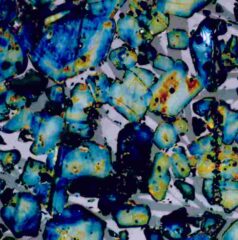
The Applied Mineralogy can provided new ideas and strategies for the development and improvement of high performance materials for optical, magnetic and sensoric applications. Focussing on the correlation of atomic arrangement in the crystal structure, chemical variability and physical property an interdisciplinary approach will be done. Apart from that, the study of phase relations and crystal chemistry are important aspects of the mineralogical research.
Research projects
Funding source: Industrie
Acronym: CAC_reactiveCc
Project leader:
Funding source: Industrie
Acronym: CAC_SCM
Project leader:
Funding source: DFG-Einzelförderung / Sachbeihilfe (EIN-SBH)
Project leader:
Funding source: DFG-Einzelförderung / Sachbeihilfe (EIN-SBH)
Project leader:
Funding source: Industrie
Acronym: SF in LCC
Project leader:
Funding source: DFG-Einzelförderung / Sachbeihilfe (EIN-SBH)
Project leader:
Funding source: Deutscher Akademischer Austauschdienst (DAAD)
Acronym: PPP-Portugal 2022-2024
Project leader: ,
Bone defects resulting from trauma, tumor removal or bone infections represent a major social challenge, exacerbated by the increasing proportion of elderly patients due to steadily rising life expectancy. The most effective treatment of such bone defects to improve the quality of life of those affected is therefore of high relevance. Despite the impressive progress in the development of synthetic materials for bone regeneration, some clinical problems still remain unsolved. Therefore, the aim o…
Funding source: Industrie
Acronym: InoJec
Project leader:
CO2-incorporation. Optimization of stability and determination of conversion rate of injected calcium aluminate cement mortars.
Funding source: Deutsche Forschungsgemeinschaft (DFG)
Acronym: Li-Silicates
Project leader: , ,
Classes of materials that resemble natural teeth, such as polycrystalline ceramics, glass-ceramics and ceramic-methacrylate composites, have been preferred for tooth replacement for some time.The first commercial product was based on a non-stoichiometric multi-component SiO2-Li2O-Al2O3-K2O-P2O5-ZrO2-ZnO system that was pre-crystallised, then melted and injected into a mould made of refractory material. The resulting glass-ceramics reached a degree of crystallisation of ~70 vol% with elongated Li…
Funding source: Bundesministerium für Forschung, Technologie und Raumfahrt (BMFTR)
Acronym: K4
Project leader:
Der Klimaschutzplan 2050 der Bundesregierung spiegelt das Pariser Klimaschutzabkommen vom Dezember 2015 als nationale Verpflichtung wider, mit dem Ziel bis ins Jahr 2030 die Treibhausgasemissionen um 55% gegenüber 1990 zu senken. Die weitgehende Treibhaus-gasneutralität für Deutschland wird bis 2050 angestrebt. Einen maßgeblichen Anteil an den entstehenden Emissionen hat mit ca. 20% der Sektor Industrie, wobei ca. 5% der CO2-Emissionen auf die Zementindustrie entfallen. Diese Emissionen haben ih…
Funding source: DFG / Schwerpunktprogramm (SPP)
Project leader:
Two substantial goals are pursued in this proposal.Initially the highly time resolved (ca. 10 min) evolution of the relevant rheology determining parameters during the early cement hydration will be traced and evaluated. Here the evolution of the specific surface area of the clinker phases, the evolution of the morphology and the amount of the forming hydrate phases as well as the availability and amount of the residual unbound and rheology active water fraction play a significant role. These pa…
Funding source: DFG-Einzelförderung / Sachbeihilfe (EIN-SBH)
Project leader:
Polymer particles have an influence on cement hydration. The aim of the suggested project is to evaluate, which of the proposed models in literature, explaining the retarding influence of polymer particles on cement hydration, is valid. Discussed are either the adsorption of polymer particles on cement surfaces or the interaction of the particles with ions on pore solution (especially Ca-ions). In the suggested project a systematic study will be conducted allowing to evaluate which phenomenon is…
Funding source: Bayerisches Staatsministerium für Wissenschaft und Kunst (StMWK) (seit 2018)
Acronym: CAC-Calcite
Project leader:
Funding source: Industrie
Project leader:
Funding source: Industrie
Acronym: Microstruc
Project leader:
Acronym: Cu-doped beta TCP
Project leader:
Funding source: DFG-Einzelförderung / Sachbeihilfe (EIN-SBH)
Project leader:
More than 4 billion tons of cement are currently produced and consumed each year. The process contributes approximately 8% to the total man-made carbon dioxide emissions and is associated to a high consumption of primary energy. Cement is used for the production of concrete, which is the most important material in construction.Compared to the importance of the material, the knowledge about the chemical reactions during hardening is only poorly developed. Understanding of the mechanisms governing…
Funding source: DFG-Einzelförderung / Sachbeihilfe (EIN-SBH)
Project leader:
Two substantial goals are pursued in this proposal.Initially the highly time resolved (ca. 10 min) evolution of the relevant rheology determining parameters during the early cement hydration will be traced and evaluated. Here the evolution of the specific surface area of the clinker phases, the evolution of the morphology and the amount of the forming hydrate phases as well as the availability and amount of the residual unbound and rheology active water fraction play a significant role. These pa…
Funding source: Deutscher Akademischer Austauschdienst (DAAD)
Project leader: ,