
Paleontology GZN participates in the exhibition “Climate Forces – Driving Forces of Evolution” at the State Museum of Prehistory in Halle
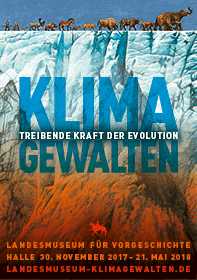
The special exhibition “Climate Forces – Driving Forces of Evolution” (http://landesmuseum-klimagewalten.de) is on display at the State Museum of Prehistory in Halle (Saale), with the Department of Paleobiology at the GeoZentrum Nordbayern participating with numerous loans with the assistance of Dr. Dieta Ambros.
The exhibition looks at climate change over long periods of time and attempts to open up new perspectives on current problems. It begins at the start of the Cenozoic era around 66 million years ago. While the climate was initially very warm, it has become increasingly unstable, particularly in the last 2.6 million years. Warm and cold periods now alternate. Flora and fauna must constantly adapt to new conditions.
The first two themes of the exhibition are devoted to the possible cosmic and terrestrial causes of natural climate change and the phenomenon of ice ages and warm periods.
Two further areas contrast the flora and fauna of the Paleogene and Neogene (“Tertiary”) periods with those of the subsequent Pleistocene.
The next rooms then examine the evolution of mammals in relation to climate events, competitive pressure, and predator-prey relationships. A central area here is primate evolution: from early lemurs to hominid development to the emergence of human species, of which ultimately only Homo sapiens survived. For the first time, humans were a species that no longer merely responded to climatic changes through biological adaptation, but actively shaped their environment. Whereas earlier primates were still prey to predators, humans evolved over time into hunters and creatures that increasingly dominated their environment. The use of tools, fire, clothing, dwellings, and hunting weapons made it increasingly possible to survive even in inhospitable conditions. In addition, humans began to engage with their environment through artistic means.
Reconstructions, dermoplastics, skeleton assemblies, and numerous life-size images bear witness to the former environment with saber-toothed cats, cave lions, giant hyenas, and mammoths. The spectacular central installation shows the battle between a mammoth bull and a young animal with several cave lions.
The Earth’s climate is currently warming rapidly in a very short period of time. However, over longer periods, an impending ice age is also conceivable. The exhibition leaves visitors with these two possible scenarios and their conceivable consequences.
The overall management of the exhibition is in the hands of Prof. Dr. H. Meller (Director of the LDA), the project manager is Dr. T. Puttkammer (LDA), and the curators are Dr. D. Ambros (Erlangen) and K. Schauer (Salzburg).