
Bachelors Degree in Geoscience
Information on application/registration for the Bachelors Degree in Geoscience
There is currently no numerus clausus on the Bachelors Degree in Geoscience at the University of Erlangen-Nuremberg.
German language skills are compulsory to study the Bachelor Geoscience in Erlangen. All courses are taught in German.
Studies begin each winter semester!
The degree program can be started each winter semester. Enrollment consists of two steps:
- Online via the portal www.campo.fau.de; the online portal is activated from early June.
- In person at the Student Records Office (Studierendenkanzlei) at Halbmondstraße 6, Room 0.034. You can find the dates for in-person enrollment at the Student Records Office here (admission-free degree programs).
Information about introductory events at FAU for the start of studies can be found here.
Information about preparatory courses (Chemistry Crash Course) can be found here.
Enrollment for the summer semester is only possible when transferring from another university within a geosciences degree program.
StudOn and Campo are two important online platforms at FAU. However, they differ significantly in their functions. Depending on what you need, either StudOn or Campo must be used.
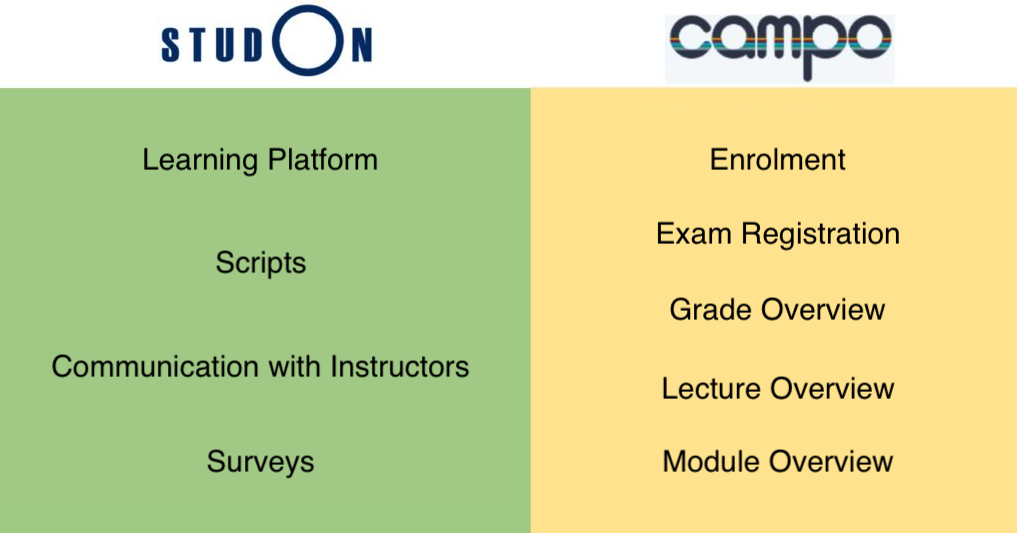
What does StudOn offer?
- Official course registration
- Access to teaching materials
- A way for instructors to quickly communicate with students, for example in case of schedule changes
What does Campo offer?
Campo is the interface to the Examinations Office. Nearly all administrative and legal matters are handled through this platform.
- Matriculation (Enrollment)
- De-registration (Exmatriculation)
- Provision of official certificates
- Submission of missing documents
- Official exam registration and withdrawal
- Grade entry by instructors
- Overview of grades
- Registration for elective courses
Campo also provides several important additional functions. It offers up-to-date information on all courses held at FAU. This is important for:
- Provision of the module handbook
- Course search
- Course catalog
- Degree program plans
- Timetable creation
- Room schedules
A tutorial on how to use StudOn and Campo can be found at the following link (German).
FAU information page on the online platforms.
Online tools for FAU students can be found here.
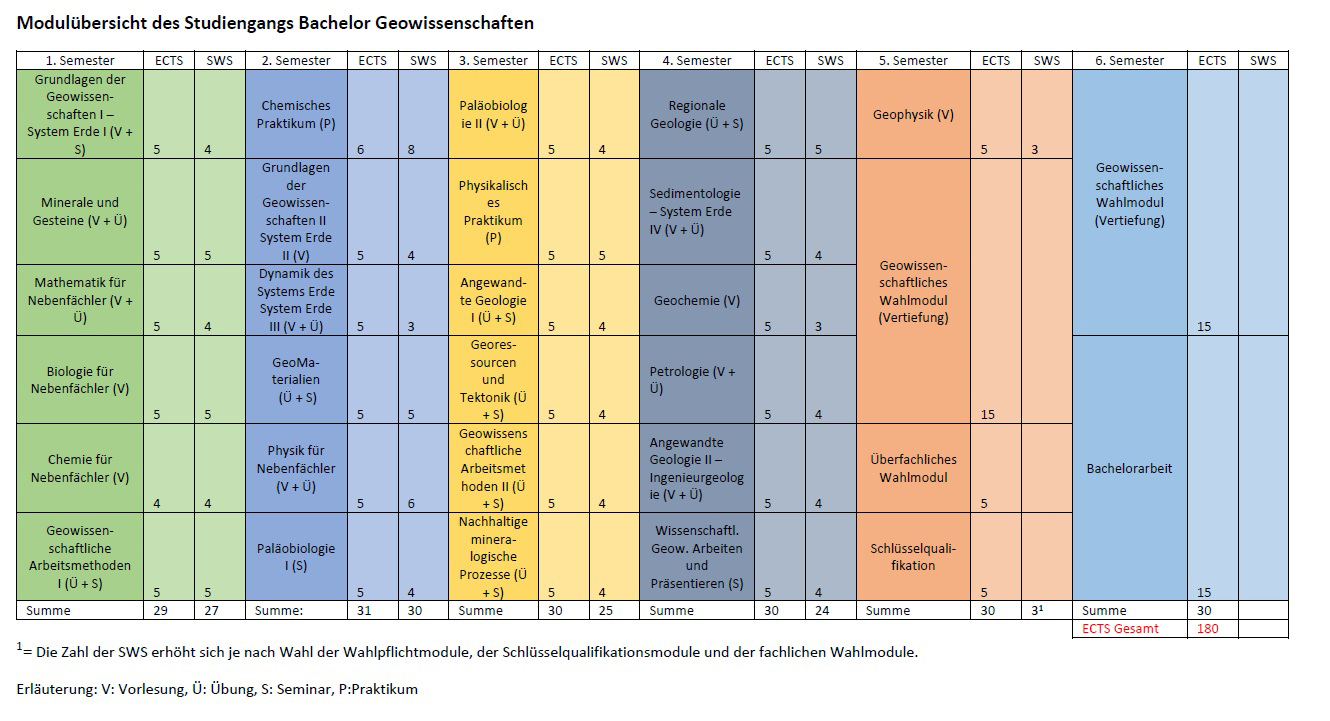
The module overview lists the individual modules of the Bachelor’s program at the GeoZentrum. You will complete each module with an examination.
The standard period of study is six semesters. Each semester consists of 30 ECTS points, the bachelor program in total of 180 ECTS.
In the first two semesters – the basic and orientation phase – you will study geoscientific basics as well as the minor subjects chemistry, physics, mathematics and biology.
You will then deepen your knowledge in a combination of seminars, laboratory and field exercises.
Here at the GeoCenter, after the fourth semester, you can choose three of the five offered fields of study and study them in depth.
In the 6th semester you will complete your Bachelor’s thesis.
Campo contains all module catalogs and information on when and where a course takes place, as well as the names and contact details of the responsible instructors. It also includes room plans and contact information for FAU staff.
Important Functions
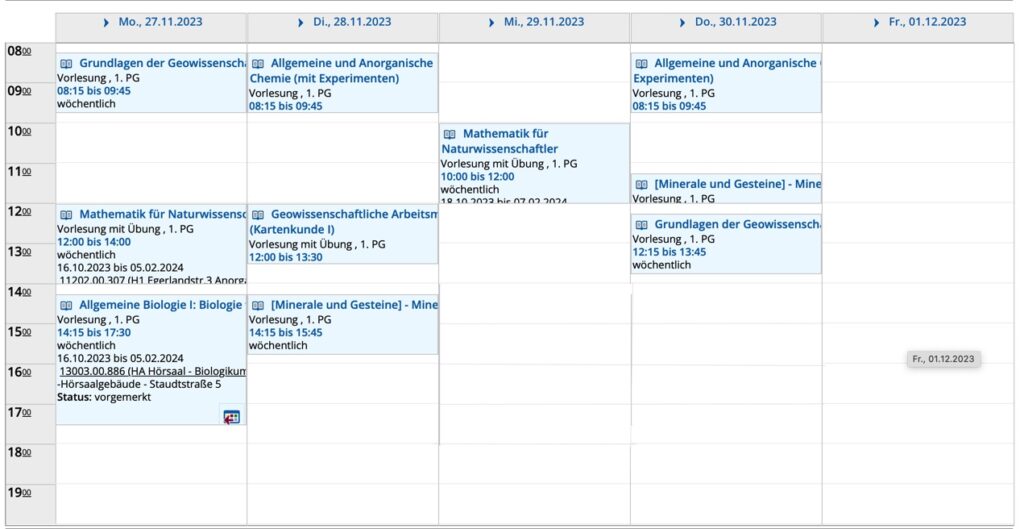
View Timetable: Campo > My Studies > Timetable
Timetable and Module Planner: Campo > My Studies > Timetable and Module Planner
All courses to be taken in the current semester are displayed.
Register for Lectures: Campo > Course Offerings > Show Course Catalog > Degree Programs of the Faculty of Sciences > Geosciences > Bachelor/Master of Science Major PO 20202 > Bachelor Examination/Master Examination > Main Account/Additional Credit > Select any course > Parallel Groups/Dates > Book Date
The booked date will then appear on your timetable.
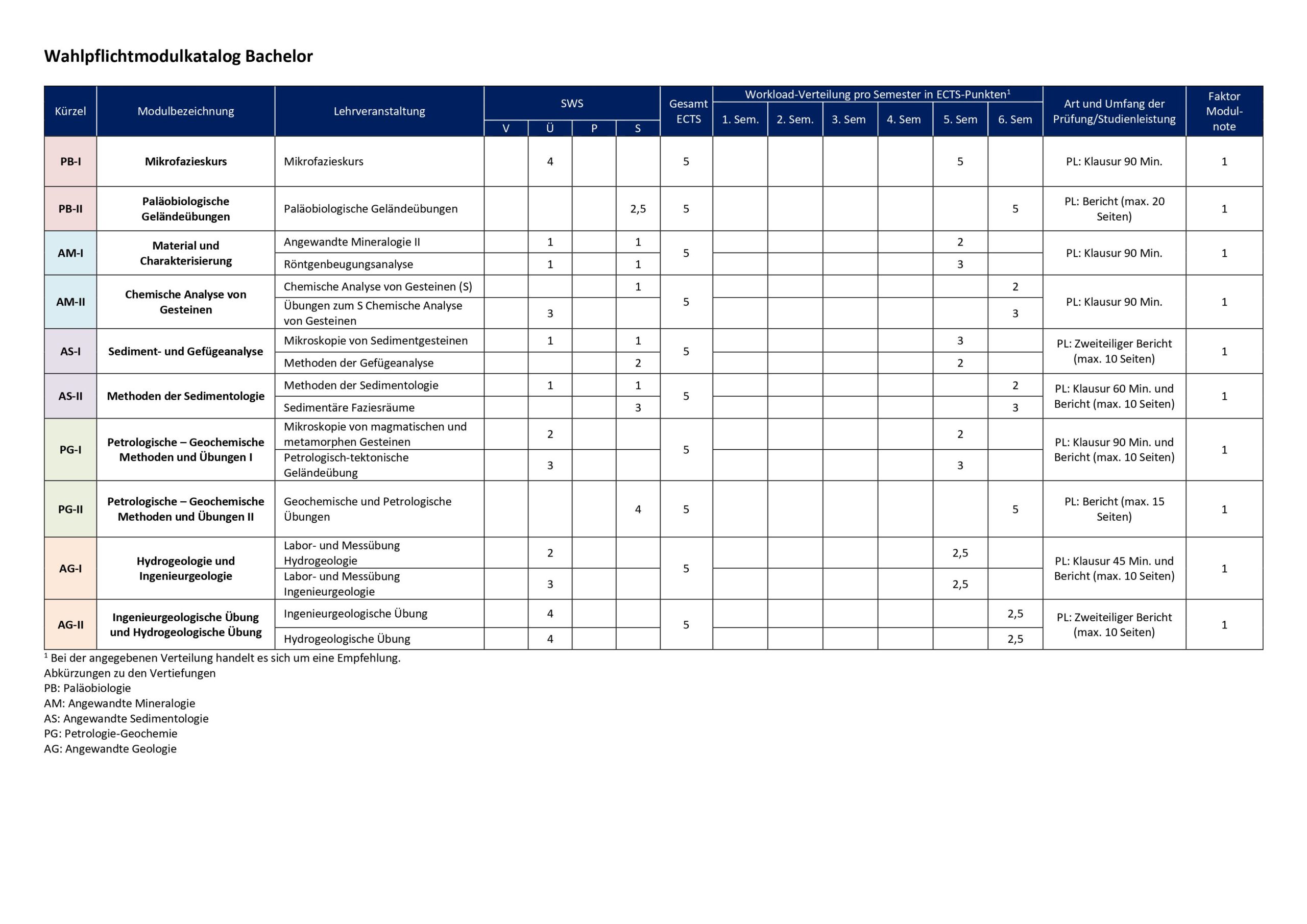
At the end of the 4th semester, you choose three out of the following five geoscience specializations for the 5th and 6th semesters:
- Applied Geology (AG)
- Applied Mineralogy (AM)
- Applied Sedimentology – Geo-resources (AS)
- Paleoenvironment – Paleobiology (PB)
- Petrology – Geodynamics – Geo-resources (PG)
The courses with module descriptions, times, and locations can be found at https://www.campo.fau.de.
Applied Geology (AG)
Applied Geology at the GeoZentrum includes two subfields: Engineering Geology and Hydrogeology.
The focus of Engineering Geology in Erlangen is on the study of geohazards such as mass movements (e.g., landslides) in low mountain ranges and the Alps. The research investigates the possible location, scale, and timing of such often catastrophic events. Methods include aerial image analysis, geodetic surveys, direct motion measurements, and soil and rock mechanics studies. Other topics in Engineering Geology include soil investigations for construction, tunnel and dam construction, geothermal energy, contaminated site investigations, and landfill construction.
Hydrogeology studies the processes of the water cycle on Earth. This includes questions about the dynamics of groundwater and surface water, maintaining and securing regional water supply, karst hydrogeology, and water chemistry. Common methods include isotope analyses and measuring concentrations of various dissolved ions in water. CO₂ storage in the subsurface is also a research focus in Hydrogeology.
Applied Mineralogy (AM)
Mineralogy in Erlangen has an applied focus. Research areas include construction chemistry (cement mineralogy), advanced ceramics (e.g., phosphors), and calcium phosphate for use as bone substitutes. Reaction processes in mineralogical systems and their influence on material properties are investigated. Main methods include X-ray diffraction and calorimetry.
Applied Sedimentology – Georesources (AS)
This specialization studies the processes leading to the formation of sedimentary rocks and the deposits of non-metallic resources contained within them, such as petroleum, natural gas, coal, and construction materials like sand, gravel, and natural stones, as well as their potential exploration. Research on geothermal energy as a renewable resource is also a focus. The thermal properties of rocks for heat and power generation in shallow and deep geothermal systems are investigated. Additionally, carbon and oxygen isotope chemistry provides insights into past climate conditions and changes in Earth’s history.
Paleoenvironment / Paleobiology (PB)
Paleobiology focuses on the evolution of the biosphere, ecosystems in Earth’s history, and the development of life. It investigates which environmental conditions and processes drive changes in organism communities. The focus is not only on historical ecosystems but also on current impacts of climate change on modern marine ecosystems. Other key areas include carbonate sedimentology, taxonomy of marine fossils, and paleoenvironment reconstruction. Research combines fieldwork in geology and paleontology with modern analytical methods and statistical analysis of large paleobiological databases.
Petrology – Geodynamics – Geo-resources (PG)
This specialization focuses on the study of geodynamic processes in the Earth’s crust and underlying mantle, which are fundamental for understanding the development of our planet. This includes magma formation inside the Earth and at active plate boundaries such as mid-ocean ridges and subduction zones. The consequences of magmatic activity for humans, e.g., volcanic eruptions, are also researched. Another focus is on magmatic ore deposits, including their formation and potential exploration. Research methods mainly involve isotope geochemistry and bulk chemical analyses of rocks.
As a key qualification in the Bachelor’s program in Geosciences (5th semester), you can include courses from any department at Friedrich-Alexander University Erlangen-Nürnberg, as long as they are offered with 5 ECTS (e.g., language courses, field exercises, lectures).
Below you will find the courses available for the interdisciplinary elective module in the Bachelor’s program in Geosciences. The interdisciplinary elective module is included in the module plan of the Bachelor’s program in the 5th semester.
Please note that the courses are only offered once a year! Therefore, courses offered in the winter semester (WS) should be taken in the 5th semester, and courses offered in the summer semester (SoSe) should be taken in the 4th semester.
Currently offered interdisciplinary elective modules for Bachelor’s students in Geosciences, each worth 5 ECTS:
1. Strukturphysik und Kristallographie (SuKGeoChem) (V) (Structural physics and crystallography),
2 SWS, 3 ECTS, Prof. Hock; in WiSs; Dates on Campo
+ Übungen zur Strukturphysik und Kristallographie (SuKGeoChem) (UE) (Exercises in Solid-State Physics and Crystallography),
2 SWS, 2 ECTS, Prof. Hock; in WiSs; Dates on Campo; Registration on Studon
2. Grundvorlesung PG I: Geomorphologie und Bodengeographie (Basics PG I: Geomorphology and Groundgeography),
5 ECTS; 2 SWS, Prof Grießinger; in WiSe; Dates on Campo
3. Grundvorlesung PG II: Klimatologie und Biogeographie (Basics PG II: Climatology and Biogeography),
5 ECTS, in SoSe; Dates on Campo
4. Freie Auswahl an Modulen aus dem Bereich “Spezielle Methoden der PG”, die sinnvoller Weise auf den Inhalten der belegten Grundvorlesung(en) aufbauen (z.B. Analyse von Klimadaten, Dendroökologie, Soil mapping. usw.) (Free courses that build upon the lectures),
5ECTS, in SoSe and WiSe
5. Organische Chemie, Grundlagen (OC 54) (V) (Organic Chemistry, Basics),
4 SWS, 5 ECTS, Prof. Dr. Mokhir; in WiSe; Dates on Campo
optional: Unterstützungsseminar 2 (CC07) zur Organischen Chemie, Grundlagen I (UE) (Support Seminar 2 (CC07) for Organic Chemistry, Fundamentals I),
in WiSe; Dates on Campo
6. Ökologische und systematische Diversität der Organismen A: Einführung in die Zoologie (VorlZoo) (V) (Ecology and systematic diversity of organisms),
2 SWS, 5 ECTS, Prof. Feigenspan, Dr. Schmidl; in WiSe; Dates on Campo
If interested, please contact Dr. Schmidl: juergen.schmidl@fau.de
7. Computing and Data Analysis,
5 SWS, 5 ECTS, Prof. Kießling and Assistants; Beginning WiSe, see Campo
Download Modulbeschreibung
8. Einführung in die Geographischen Informationssysteme für Geologen (GIS I) (Introduction geographic informationsystem for geologists), 3 SWS, 5 ECTS, Dr. Krumm; in WiSe; Dates on Campo
9. Seminar Rohstoffe und Nachhaltigkeit (Resources and Sustainability),
2 SWS, 5 ECTS, Prof. K. Haase, Dr. A. Regelous, only in SoSe, Dates on Campo, Registration via StudOn.
10. Nachhaltiges Wassermanagement (Seminar)(Sustainable water management),
2 SWS, 5 ECTS, Prof. G. Chiogna, only in WiSe, Dates on Campo, Registartion via StudOn.
11. Hypothesis Testing in Paleobiology (Seminar),
2 SWS, 2.5 ECTS, Dr. R. Warnock, only in WiSe, Dates on Campo
12. Sustainable Resources and global ethical partnerships (Online Kurs),
2 SWS, 5 ECTS, Dr. A. Regelous, Prof. D. Köhn, only in SoSe, Dates on Campo, Registration via StudOn
13. Introduction to Geomicrobiology (Seminar),
3 SWS, 5 ECTS, Dr. Anna-Neva Visser, only in WiSe, Dates on Campo
Abbreviations:
SoSe = Summer Semester; WiSe = Winter Semester
V = Lecture, UE = Exercise