
Talks and Workshops
Field trip to Kropfmühl Graphite Mine on April 17, 2026
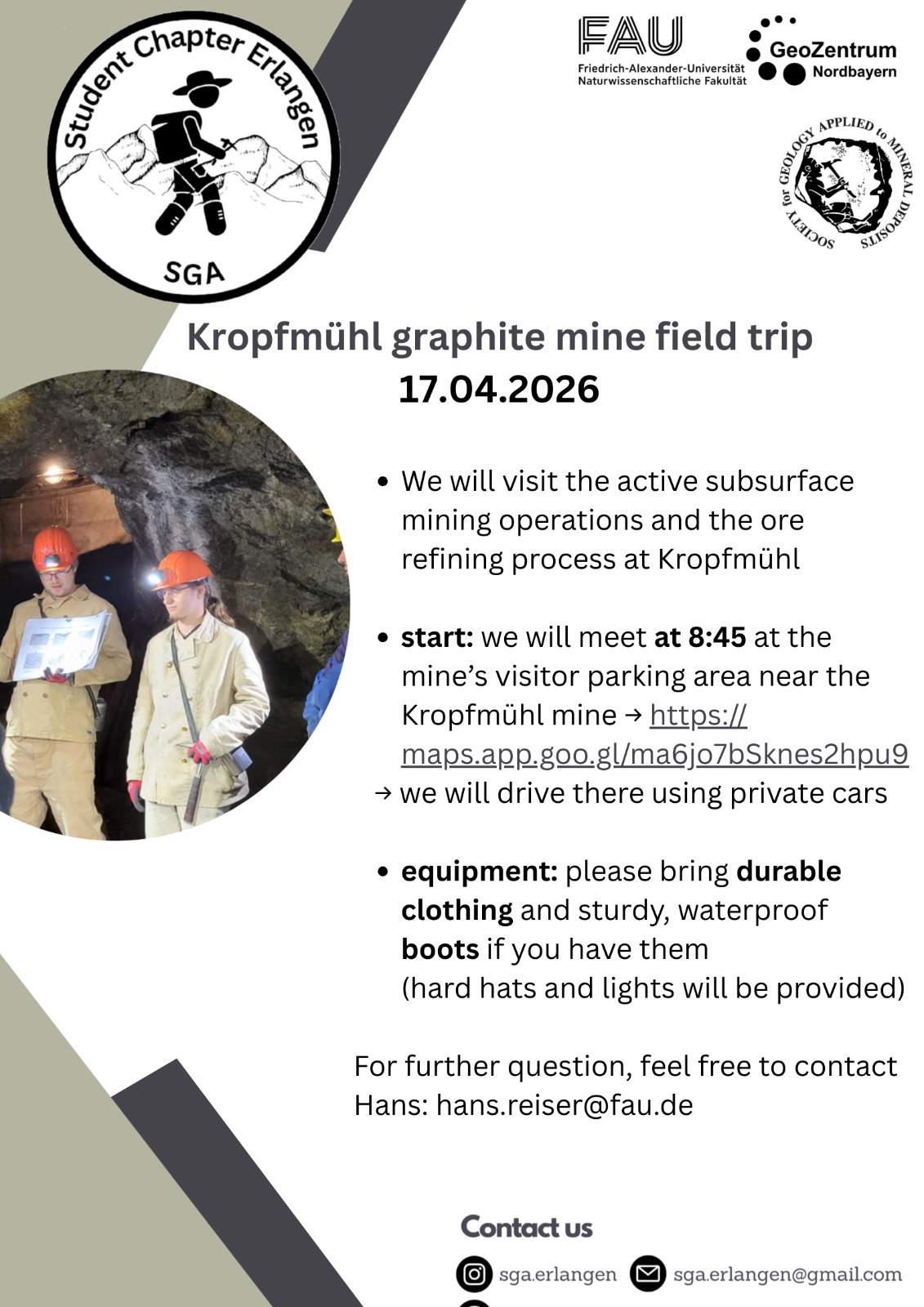
We’re excited to announce another field trip to the Kropfmühl Graphite mine. 🪨 🔨
We will visit the active subsurface mining operations and the ore refining process at Kropfmühl (near Passau, Bavaria). 📍
Start: we will meet at 8:45am at the mine’s visitor parking area near the Kropfmühl mine.
⚠️ Please note that each participant is responsible for their own travel arrangements. You may carpool with other participants, but this must be arranged among yourselves.
There is no entrance fee besides fuel costs.
Equipment: Please bring durable clothing and sturdy, waterproof boots if you have them (Hard hats and lights will be provided). 🥾
Participant limit: 12
(ℹ️ This trip is not limited to SGA members from Erlangen only. External participants from other student chapters can also apply.)
For further questions and applications, feel free to contact Hans Reiser: hans.reiser@fau.de
Or the SGA Student chapter Erlangen: sga.erlangen@gmail.com
„Antimony isotopes from ore deposits to the global ocean“ by Prof. Dr. Juraj Majzlan
On January 12th Prof. Dr. Juraj Majzlan from the Friedrich-Schiller-Universität Jena visited us and gave a talk about antimony isotopes.
“The Mineral System of magmatic Ni-Cu-PGE sulfide deposits revisited by an experimental petrologist” by Giada IACONO-MARZIANO
On November 17th 2025 Giada IACONO-MARZIANO, a CNRS researcher working at the Institut des Sciences de la Terre d´Orléans in France, visited us to present her work on “The Mineral System of magmatic Ni-Cu-PGE sulfide deposits revisited by an experimental petrologist”.
“Copper and Gold Metallogeny of the Western Altaids (Central Asia)” by Prof. Dr. Reimar Seltmann
On January 27th 2025 Prof. Dr. Reimar Seltmann from the Natural History Museum in London held a talk about “Copper and Gold Metallogeny of the Western Altaids (Central Asia)”.
“Volcanic stratigraphy, geological models, drill targets: Surface mapping in the Kristineberg VMS camp, Skellefte ore district, Northern Sweden as exploration tool” by Dr. Sci. Net. Majka Christiane Kaiser
On October 28th 2024 Dr. Sci. Net. Majka Christiane Kaiser visited us to give a talk about “Volcanic stratigraphy, geological models, drill targets: Surface mapping in the Kristineberg VMS camp, Skellefte ore district, Northern Sweden as exploration tool” where she outlined Boliden’s exploration strategies over time in the Skellefte ore field, the geological challenges, model-based exploration, the recent mapping project in the area and an evolving geological model with its significance for future drilling.
“The Geology of Scotland Explained by That Girl That Makes Videos About Rocks” by Luisa Hendry A.K.A. Scottish Geologist
On May 13th 2024 Luisa Hendry, better known as Scottish Geologist on instagram, visited us to talk about the stunning geology of Scotland and it’s breathtaking Highlands, as well as the role of social media as a modern outreach tool in the geology community. It was a great pleasure to have her visiting us!
“Pushing the Limits of how we study the deep mantle in the 21th century” by Dr. Kate Kiseeva
On January 22nd 2024 Dr. Kate Kiseeva from the American Museum of natural history, New York, gave a talk about “Pushing the Limits of how we study the deep mantle in the 21th century”. She gave a brief history of what we know about the Earth’s upper mantle (<660 km) and how this information is obtained.
“The chain of Processes forming Porphyry Copper Deposits” by Prof. em. Dr. Christoph A. Heinrich
On January 15th 2024 Prof. em. Dr. Christoph A. Heinrich from ETH Zurich joined us for a talk about his brand new review paper about porphyry copper deposits. He presented us his topic of “The chain of processes forming porphyry copper deposits”.
“The Global Gold Cycle” by Prof. Dr. Hartwig Frimmel
On July 3rd 2023 were honoured to host Prof. Dr. Hartwig Frimmel from the University of Wuerzburg, Germany, for his talk on “The Global Gold Cycle”. He told us a lot about several different types gold deposits and when gold was first concentrated in Earth’s history.
“Tracing Metal Fluxing Through the Lithosphere from Magmatic Sulfide Through Porphyry to Epithermal” by Dr. David Holwell
On June 19th 2023 Dr. David Holwell from the University of Leicester gave a talk within our lecture series. It was a great pleausure to have our first international guest visiting!
“From IT to Geology: Trade Mouse for Hammer (and back) – Exploring mineral ressources in Germany” by Marcel Hanisch
What a way to announce our new SGA student chapter Erlangen! We are proud to say that our SGA Kickoff Event on May 4th 2023 was a great success. We started off by presenting the new student chapter with everything we have planned for the future. We are always open for new ideas and projects and of course interested students to join us.
We had a very interesting talk by Marcel Hanisch on his academic career of becoming a geologist and his daily work in the gypsum exploration industry. The Knauf GmbH is a major global player in the gypsum industry and is active in more than 40 countries. We mostly talk about metals in the exploration industry and sometimes forget how exciting and valuable a career in the field of industry minerals can be. Many thanks to Marcel for showing us the diverse facets of gypsum exploration. It really was a great starting event for our SGA student chapter.
Of course, the event was not quite done with the end of the talk. We still had a nice BBQ prepared outside the Geozentrum Nordbayern for everyone interested. This was a great opportunity to talk to Marcel, professors and other students interested in economic geology. We would like to thank everybody who joined the talk and the BBQ afterwards and we hope to see you next time!